 Skip to content
Industrial Park Paving in Bulverde & the Texas Hill Country
Industrial Park Paving in Bulverde, TX and the Texas Hill Country, with free written estimates and the owner on every job. Durable industrial park paving for industrial zones across the Texas Hill Country, built to withstand heavy loads.













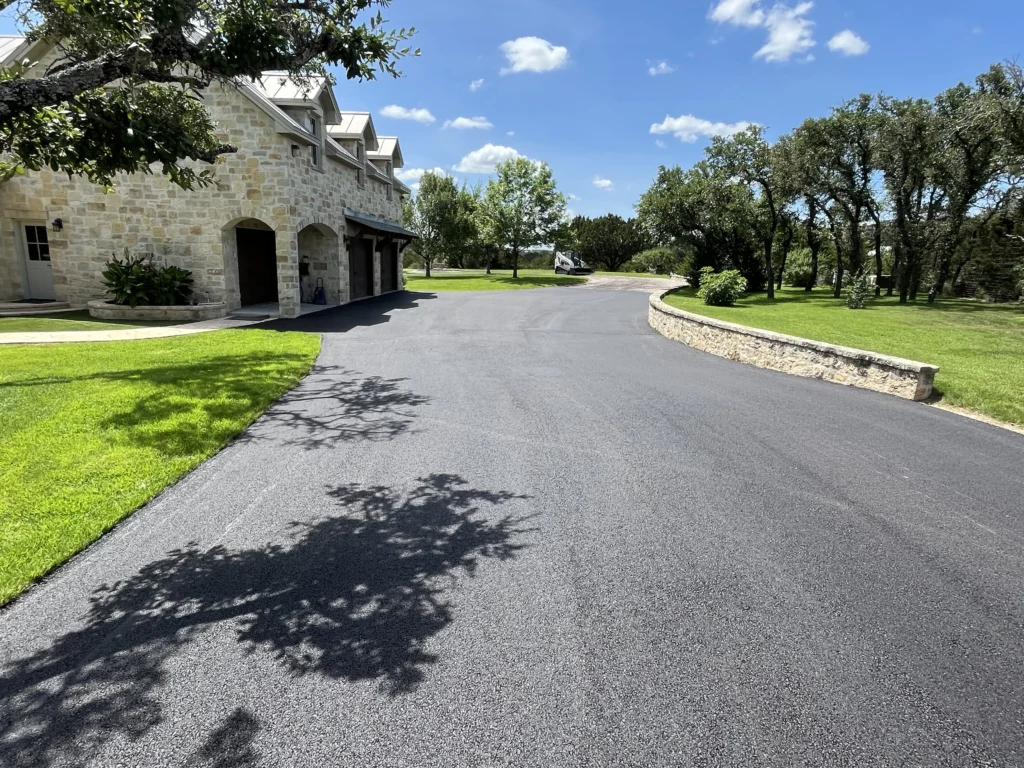
Industrial Park Paving Solutions for Texas Hill Country Businesses
At the campus scale, industrial park paving is a different undertaking than a single-facility project. Industrial parks in Texas Hill Country and Central Texas serve multiple tenants, manufacturing operations, distribution centers, fabrication shops, and service contractors, each generating their own traffic patterns, load profiles, and access requirements across a shared road and parking infrastructure. The internal road network that serves the whole park carries the combined load of every tenant’s inbound delivery, outbound shipment, and vendor visit. When that network is built to a single generic spec, the sections carrying the heaviest truck traffic fail first while lower-use areas remain in good condition, creating a patchwork maintenance problem that compounds over time.
Industrial parks across Central and South Texas also face a planning challenge that single-site facilities don’t: the paving scope grows as the park builds out. Phase one infrastructure needs to be designed with phase two and three tenant pads in mind, so future construction traffic doesn’t destroy the roads that existing tenants depend on. The Federal Highway Administration identifies load repetition and base depth specification as the two variables with the greatest impact on industrial roadway service life. Building to anticipated peak loads, not current tenant loads, at the time of initial construction is the most cost-effective approach to industrial park pavement management.
Brooks Paving provides industrial park paving in Bulverde and serves developers, property managers, and campus owners throughout the Texas Hill Country, Central Texas, and South Texas. We handle full-campus paving scopes, from site grading and base prep through hot-mix asphalt installation, truck terminal aprons, and line striping, and structure estimates by zone so developers can phase construction to match their buildout schedule and capital availability. Every estimate is written. Every scope is documented before work begins.
Comprehensive Industrial Park Paving Services
We handle full-scale paving projects for factories, business parks, and industrial complexes across Central Texas.
Heavy-Duty Asphalt for Industrial Park Roads and Tenant Pads
The internal roads of an industrial park carry a different load profile from a commercial parking lot or a single facility's access road. A multi-tenant park with warehouse, manufacturing, and logistics tenants generates mixed traffic, passenger vehicles, delivery vans, single-unit trucks, and fully loaded 80,000 lb semi-trucks, all on the same road network. Designing the road network to the lightest expected load means the truck-traffic sections fail within years. Designing everything to full truck spec means overbuilding sections that only see passenger traffic.
The right approach is zone-specific design: truck-route sections and tenant pad entries built to industrial spec (10-14 inch base depth, high-stability modified binder), internal circulation roads to a medium standard (8-10 inch base), and employee parking areas to commercial spec (4-6 inch base). The Asphalt Institute's SuperPave specification provides the performance-graded binder selection framework for Texas temperature extremes, we apply it at the zone level, not a single specification for the whole park. See our heavy-duty asphalt paving page for the complete base depth and mix specification framework.
Large-Scale Site Preparation and Sub-Grade Development
Industrial park paving starts with the ground beneath it. In the Texas Hill Country and Central Texas, site preparation for large industrial footprints requires addressing limestone outcropping, variable soil bearing capacity across the site, and drainage design for an impervious surface that may cover several acres. Hill Country sites built over shallow limestone require rock excavation and backfill at low-bearing-capacity zones before base placement. Sites with expansive clay sub-grades, common in parts of Central Texas, require lime stabilization or structural separation layers to prevent sub-grade movement from translating into surface cracking.
The Environmental Protection Agency's stormwater regulations require that development projects over one acre prepare and implement a Stormwater Pollution Prevention Plan (SWPPP) and manage runoff from new impervious surfaces. Industrial park development consistently meets or exceeds that threshold. We coordinate drainage design with the overall site civil plan and can handle cut, fill, grading, and base preparation as part of the complete paving scope. See our site grading and excavation page for detail on what we deliver before the paver rolls.
TRUCK TERMINALS AND LOADING AREAS
Truck terminal and truck stop surfaces carry the most demanding load conditions in any industrial park, fully loaded semi-trucks at 80,000 lbs maneuvering at low speed through turning radii designed for 53-foot trailers, then sitting stationary at dock doors or fuel island positions in Texas summer heat. The combination of lateral shear stress during slow turning, sustained static load at fixed stop positions, and high surface temperatures creates a failure profile that standard asphalt binder grades cannot resist.
Truck terminal aprons, fuel island pads, and dock approach surfaces require a Portland cement concrete or high-polymer-modified asphalt specification at stop positions, and a heavy-duty asphalt specification on maneuvering lanes and approach roads. We assess each zone of a truck terminal or truck stop separately during the site visit, identifying stop zones, turning paths, and approach lanes, and specify the appropriate surface type for each. For industrial parks with truck stop or fleet terminal tenants, this zone-specific approach prevents premature failure at the highest-cost-to-repair locations on the property.
Industrial Park Infrastructure: Entrances, Signage Pads, and Phased Buildout Roads
An industrial park's first impression is formed at the entrance, the condition of the entry road, the delineation of the main drive, and the visibility of tenant pad addresses. Beyond curb appeal, the entry road also carries the full traffic load of every tenant, visitor, and delivery on the property and requires the highest maintenance priority in the road network. We design and build entrance roads and main drives to commercial-arterial standards, with proper turning radius geometry for semi-truck ingress, clear sight lines, and drainage that prevents puddle formation at the entry transition.
For parks in active buildout, we phase infrastructure roads to accommodate construction traffic during tenant pad development without destroying the base and surface installed for existing tenants. Temporary construction traffic phases, haul road surfaces, and the sequencing of permanent road installation relative to tenant construction are planned and documented before any paving begins. Phased delivery allows developers to build the park road network on a schedule tied to tenant occupancy and capital deployment rather than requiring full infrastructure investment before the first tenant arrives. See our factory floor access roads page for related campus road infrastructure applications.
Why Texas Industrial Parks Choose C. Brooks Paving

A+ BBB Accredited
Accredited with the Better Business Bureau and maintaining an A+ rating since our founding.
Owner on Every Job Site
Courtnay Brooks is present at every project. You’re not handing your property over to a subcontractor.
All Work Guaranteed in Writing
Every estimate and every job is documented. No verbal promises. No hidden charges.
State-of-the-Art Equipment
We run Etnyre, Bear Cat, and Leeboy equipment, some of the best chip seal and asphalt machinery available in the region.

Our Industrial Park Paving Process
Free Estimate & Site Visit
We’ll come out, look at the project, and give you a clear price.
Proposal
We will gather all the information and provide you with a detailed scope of the project that fits within your budget and timeline
Construction
The work is scheduled and construction begins while you are kept in the loop every step of the way
Free Estimate & Site Visit
We’ll come out, look at the project, and give you a clear price.
Proposal
We will gather all the information and provide you with a detailed scope of the project that fits within your budget and timeline
Construction
The work is scheduled and construction begins while you are kept in the loop every step of the way
Frequently Asked Questions About Industrial Park Paving
Where in Texas do you serve?
We serve industrial park developers, property managers, and industrial campus owners across 25 communities, from Boerne and Spring Branch in the Hill Country to San Marcos, Seguin, and Pleasanton in the Central Texas corridor and Carrizo Springs and Hondo in South Texas. Our industrial park paving in Bulverde, Wimberley, Stonewall and Hunt puts us within range of the region’s primary industrial and logistics development areas. See the full service coverage on our service areas page.
Is chip seal paving suitable for Texas weather conditions?
Chip seal is well-suited to Texas weather conditions and performs effectively on lower-volume industrial park roads, perimeter service roads, and secondary access routes where full hot-mix asphalt isn’t operationally required. Central Texas summer heat and the region’s temperature range are within chip seal’s design envelope when the correct binder is used. For primary park roads carrying regular semi-truck traffic, and for all truck terminal and dock approach surfaces, hot-mix asphalt or concrete is the appropriate specification. Many industrial parks use both: hot-mix on the main drive and tenant entries, chip seal on lower-use perimeter roads. See our chip seal paving page for where chip seal fits in an industrial park road planning decision.
Why is chip seal paving popular in Texas?
Chip seal’s popularity in Texas is driven by its cost efficiency on lower-volume roads combined with its performance in the region’s climate. A chip seal surface on a well-prepared base provides effective dust control, weather resistance, and a stable driving surface at significantly lower cost per lane-mile than full hot-mix construction. For industrial parks with internal service roads that don’t carry heavy truck traffic, chip seal extends the road budget while maintaining functional surfaces throughout the park. C. Brooks Paving has more experience with chip seal in the Texas Hill Country and Central Texas than almost any other paving contractor in the region, it’s our most frequently specified product and the application we’ve been doing for four generations.
How long does a typical paving project take?
Project duration for industrial park paving varies widely by scope. A single tenant pad and entry drive can be completed in 2-5 days. A phased park road infrastructure project covering the main drive, multiple tenant entries, and parking areas may run 2-4 weeks. Full-campus buildout paving for a new industrial park development is typically phased over the construction timeline, often 3-12 months, so permanent roads are installed as tenant construction completes rather than all at once. We provide a specific phase schedule in the written estimate based on your buildout plan, so you know the paving timeline before committing to any scope.
Do you only offer chip seal paving, or do you do full hot-mix asphalt?
Both. Hot-mix asphalt is the right specification for primary industrial park roads, truck terminal surfaces, dock approach aprons, and tenant pad entries carrying regular heavy vehicle traffic. Chip seal is the right specification for lower-volume service roads, perimeter access roads, and secondary roads where cost efficiency matters more than surface smoothness. Most industrial park projects use a combination, hot-mix where load and traffic density demand it, chip seal where they don’t. We assess each road segment during the site visit and specify the appropriate surface type for each zone.
Can you phase the paving to match our park buildout schedule?
Yes. Phased paving is standard practice on industrial park development projects. We design the infrastructure road network to accommodate future construction traffic loads during buildout, and we sequence permanent paving installation to coincide with tenant pad completion in each phase. Temporary haul road surfaces keep existing tenant access intact during active construction phases. The phase plan is documented in the written estimate, you’ll know which roads get paved in which phase, at what cost, and on what schedule before committing to any scope. If your buildout timeline shifts, we can adjust the phase sequence accordingly.
Do you handle line striping and signage after the paving is complete?
Yes. Line striping, park road lane markings, tenant pad address markings, truck terminal lane delineation, ADA-accessible parking markings, and fire lane striping, is part of our complete industrial park paving scope. We don’t hand off to a separate striping contractor. For truck terminal zones within the park, lane markings and dock approach delineation are safety-critical, they direct semi-truck maneuvering at speed in a confined space. We design striping layouts that meet the operational requirements of the facility and document them in the written estimate. See our line striping page for full detail on what we include in industrial facility completions.
Industrial Park Paving Across Bulverde and the Hill Country
- We proudly serve: