 Skip to content
Asphalt Paving and Chip Seal Contractor for Harper and the Texas Hill Country
Professional asphalt paving services in Harper, TX. Commercial and residential paving built for Texas Hill Country conditions. Free estimates from local experts.













Professional Asphalt Paving Services in Harper, TX
Harper sits on US-290 in western Gillespie County, an unincorporated Hill Country community built around ranching, agriculture, and the Harper Independent School District that serves families spread across hundreds of square miles of rural Gillespie County terrain. There is no City of Harper with a public works department, no municipal road maintenance budget, and no commercial tourism corridor. What there is: working ranches with long caliche driveways, private roads connecting ranch gates to homesteads, stock pens and equipment yards that need all-weather paved surfaces, and a small commercial strip along US-290 that serves the local agricultural community. In Harper, paving is a functional infrastructure decision, not a curb appeal project. The question is almost never hot-mix versus chip seal. It is whether to pave at all, and if so, how to spec it to last on limestone and caliche sub-grade in a climate that runs from hard freezes in January to 100-plus-degree July heat with minimal shade.
C Brooks Paving serves Harper and western Gillespie County from our base, reaching Harper via US-87 North to US-290 West, approximately 75-80 minutes of drive. We work in the area regularly, scheduling Gillespie County projects alongside our Fredericksburg and Kerrville work. For Harper ranch and residential properties, chip seal over properly prepared caliche base is the standard recommendation for any driveway longer than 150 feet, it handles the sub-grade conditions, the agricultural vehicle loads, and the weather cycling this part of the Hill Country delivers at a cost that makes economic sense for a rural property owner. We carry out a free site visit, assess sub-grade and drainage, and deliver a written estimate that specifies exactly what you’re getting before any work begins.
get A FREE quote !
Complete Asphalt Paving Solutions for Harper Properties
Residential Chip Seal and Asphalt Paving in Harper
Residential paving in Harper is almost entirely a rural ranch property question. The community has no dense in-town neighborhood grid, homes are spread across large lots and acreage tracts along county roads and private ranch lanes in western Gillespie County. A typical Harper residential paving project is a driveway that runs several hundred feet from a county road or US-290 access to a homestead, across native limestone and caliche terrain that turns to mud in rain and generates dust in dry months. The goal is a stable, all-weather surface that handles daily family vehicles plus the occasional loaded pickup, stock trailer, or delivery truck.
Chip seal is the appropriate surface for the large majority of Harper residential driveways. It performs well on Gillespie County's shallow caliche-over-limestone sub-grade, handles the traffic profile of a rural residential property, and costs significantly less per foot than full hot-mix asphalt on long runs, which matters on driveways measuring in hundreds of feet rather than dozens. We assess sub-grade depth and drainage flow during the site visit and include proper base preparation in the scope. A chip seal applied over unprepared or soft sub-grade fails early regardless of application quality, we address the base before the surface. See our chip seal and tar-and-chip page for detail on what the application involves.
Commercial and Community Paving in Harper
Harper's commercial footprint is small but real, the US-290 corridor through the community includes feed and supply businesses, small retail, and the facilities of Harper ISD, which operates a school campus serving Gillespie County's rural western students. Commercial paving in Harper is not a tourism-facing project. It is a functional infrastructure project: a feed store parking area that needs to hold up under loaded farm trucks without rutting out in summer heat, a school parking lot and bus loop that handles daily traffic from a student body drawn from dozens of miles of ranch country roads, or a ranch supply business lot where heavy pickups with gooseneck trailers maneuver in and out regularly.
For Harper ISD and similar institutional facilities in the community, paving scope typically includes adequate base depth for heavy vehicle loads, drainage grade that handles the runoff from impervious pavement surfaces in a low-infrastructure rural setting, and line striping that meets basic accessibility and traffic flow requirements. We provide written estimates for commercial and institutional scopes formatted clearly enough to support a school board or small business owner's budget review. See our parking lot paving and repair page for the commercial project framework and our school asphalt paving page for the specific considerations of school facility paving.
Asphalt Repair and Resurfacing in Harper
Existing paved surfaces in the Harper area such as driveways, commercial lots, and the Harper ISD campus, face the same deterioration pattern seen across western Gillespie County: surface oxidation from intense Hill Country UV exposure, edge cracking where shallow caliche base has been undercut by lateral water movement after rain events, and thermal cracking from the annual temperature range that swings from below-freezing winter nights to triple-digit summer afternoons. The Asphalt Pavement Alliance documents that maintained asphalt achieves 25-30 year service life versus 10-12 years for surfaces that skip maintenance cycles, the gap is especially pronounced in high-UV, high-temperature-range climates like western Gillespie County's.
Crack sealing before the wet season closes surface fissures before water infiltrates the base. Sealcoating protects the binder from UV oxidation that causes premature brittleness. For chip seal surfaces that have shed aggregate or thinned after 10-15 years, a fresh chip seal application over intact original base restores the surface at a fraction of new-installation cost. We assess each surface honestly during the site visit and recommend the scope that makes economic sense for the property, not the scope with the highest dollar value. See our asphalt crack repair page for the full maintenance services scope.
Paving for Harper's Heat, Dust, and Agricultural Traffic
Harper's working ranch environment creates paving conditions that suburban and in-town surfaces never face. Ranch driveways and equipment yards in western Gillespie County handle loads that are heavier and more varied than a typical residential driveway: loaded stock trailers pulling goosenecks, hay trucks, water trucks filling troughs during dry months, and occasional heavy equipment moving through the ranch for fencing or brush work. These loads impose point stress on the surface at locations that change with each vehicle pass, different from the predictable lane-pattern stress of a commercial parking lot.
The design response to agricultural traffic variability is base depth and binder quality, not surface type alone. A chip seal or hot-mix surface installed over an adequately deep compacted base handles the load variance that Harper ranch traffic delivers. The same surface installed over a thin or poorly compacted base develops ruts and edge failures within the first few seasons of heavy use. We specify base depth based on the actual traffic profile of the property, we ask what vehicle types use the surface and how often, and include that specification in the written estimate so there are no surprises when the work is complete. The Asphalt Institute's mix design and specification guidance provides the technical foundation for matching base and surface spec to traffic load, which is the step most Harper paving contractors skip by quoting to a standard spec regardless of use.
Asphalt Solutions Built For Harper Properties
Paving on Western Gillespie County's Limestone Terrain
Harper sits on the Edwards Plateau, the vast limestone formation that underlies the Texas Hill Country from the Balcones Escarpment westward. In western Gillespie County, the Edwards Limestone is close to the surface, with a thin caliche cap overlying bedrock across much of the ranch land. This creates a specific challenge for paving: there is limited depth of workable native material for base compaction before you hit hard rock. On properties where bedrock is within 4-6 inches of the surface, there is not enough native material to compact into a deep base without importing aggregate, which adds cost but is necessary for a surface that won't fail at the edges within the first few seasons.
The terrain also creates drainage challenges that are different from more soil-covered areas. Water on shallow limestone sub-grade does not percolate downward, it runs laterally along the rock surface to the nearest low point. Driveways laid across a slope without attention to cross-drainage develop edge erosion quickly as water runs along the edge of the pavement and undercuts the base from the side. We assess bedrock depth and drainage direction during every Harper site visit and include base import requirements and drainage design in the written estimate before any surface work begins.
Designing for Harper's Full-Range Hill Country Climate
Western Gillespie County experiences the full range of Hill Country climate stress on pavement: hard freezes from December through February that crack surfaces that have lost binder flexibility, intense summer UV exposure that oxidizes and brittle the surface binder, and the alternating wet-dry cycle of Hill Country weather that delivers months of drought followed by intense rain events that stress drainage design. Asphalt surfaces in Harper that are installed with the correct binder grade for the local high-low temperature range and maintained on schedule handle this full range without significant deterioration. Surfaces installed to a generic spec without regard to local climate cycling begin to show thermal cracking within 5-8 years.
The Asphalt Institute's SuperPave performance-graded binder system matches binder selection to the actual high and low pavement temperatures at the project site. For Harper and western Gillespie County, the correct binder must resist shear deformation at summer pavement surface temperatures exceeding 140°F while maintaining flexibility at the cold-temperature extreme to resist thermal cracking. Selecting the right binder grade is a specification decision, not a commodity, it is the variable that most separates a surface that holds up through ten Hill Country summers from one that cracks in the third winter.
Working with Shallow Limestone and Caliche in Western Gillespie County
The sub-grade challenge in Harper is not caliche depth variability, as it is in Blanco County's valley bottoms, or granite surface irregularity as it is near the Llano Uplift to the north. In western Gillespie County, the challenge is consistent shallow bedrock with a caliche cap that varies from a few inches to a foot or more depending on slope position and local geology. On upland ridge positions, caliche is thin and bedrock is close, limiting native base depth and requiring imported base aggregate for adequate structural depth. In creek-bottom and draw positions, caliche is deeper and more workable but carries more moisture risk from drainage concentration.
This means sub-grade assessment in Harper is a slope-and-position evaluation, not just a soil test. A ranch driveway that crosses a ridge, a mid-slope, and a creek draw in a single run has three different sub-grade conditions that may require different base treatments in different segments. We identify these variations during the site visit and note them in the written estimate, not as a source of additional charges, but as an accurate documentation of what the project actually requires to perform for 15-20 years rather than 5.
Asphalt vs. Concrete for Harper Properties
Why Concrete Is Rarely the Right Choice for Harper Ranch Properties
Concrete driveways are an uncommon choice in the Harper area for practical reasons that go beyond cost. The shallow limestone sub-grade of western Gillespie County provides limited depth for the granular sub-base that concrete slabs require for uniform support. When concrete is poured over a sub-base that varies in depth and compaction, as is typical on ranch terrain where bedrock proximity changes across the site, the slab settles unevenly at low-support points, producing cracked panels and heaved joints within 10-15 years. Panel-by-panel replacement is the only remedy, and it costs substantially more than chip seal resurfacing on the same driveway.
Concrete also fails the agricultural traffic test in a specific way: sharp steel edges, trailer hitch frames dragging across concrete as goosenecks are hitched or unhitched, equipment tracks, and loaded pallet jacks moving between a concrete surface and a loaded trailer, chip and spall concrete surface edges quickly. Asphalt in both hot-mix and chip seal form handles this kind of incidental hard contact without the edge-spalling pattern concrete develops. For Harper ranch properties, the choice between hot-mix and chip seal is a length and traffic-frequency decision. The choice between asphalt and concrete is not a close call.
Narrow Applications Where Concrete Makes Sense in Harper
Concrete has its place on Harper ranch properties in specific structural applications: working pen and chute footings where concentrated livestock loading occurs on fixed points, shop floor slabs where petroleum and agricultural chemical exposure would deteriorate asphalt, water tank and trough pads that require a smooth impermeable surface for hygiene and cleaning, and equipment shed aprons where stationary heavy equipment sits for extended periods without moving. In these applications, concrete's resistance to concentrated point loading, chemical exposure, and surface wear makes it the correct material.
For all surface transportation uses like driveways, parking areas, equipment yard access, and ranch roads, asphalt or chip seal is the appropriate choice for Harper properties. The sub-grade, agricultural traffic, and climate conditions that define western Gillespie County favor flexible pavement over rigid pavement in every transportation application.
Chip Seal: Built for Ranch Country
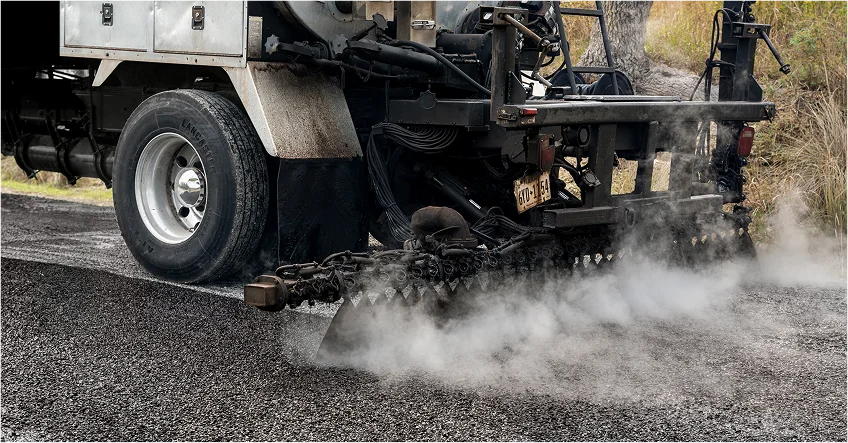
Chip seal is not a compromise for Harper ranch properties, it is the surface type specifically suited to the terrain, traffic, and economics of this part of the Hill Country. The Gillespie County road system that connects Harper to the surrounding ranch land is built on chip seal, and it has performed reliably under agricultural and ranch vehicle traffic for decades. A chip seal driveway installed over properly compacted caliche base, with bedrock depth assessed and base import specified where needed, handles the pickup, stock trailer, and light agricultural traffic of a working ranch property for 10-15 years before a fresh application is needed.
The economics are straightforward: for a Harper ranch driveway measuring 400-800 feet, a common driveway length in this area, chip seal installation costs 50-70% less than equivalent hot-mix asphalt. That cost difference funds multiple refresh applications over the same period that one hot-mix installation would cover. On ranch properties where paving budgets are real constraints, chip seal delivers more coverage and better return over time. The one requirement is that the base is prepared properly before the surface is applied, which is why our process starts with a site visit and sub-grade assessment, not a square-footage calculation over the phone. See our chip seal and tar-and-chip page for full guidance.
Our Professional Asphalt Paving Process in Harper
Free Estimate & Site Visit
We’ll come out, look at the project, and give you a clear price.
Proposal
We will gather all the information and provide you with a detailed scope of the project that fits within your budget and timeline
Construction
The work is scheduled and construction begins while you are kept in the loop every step of the way
Free Estimate & Site Visit
We’ll come out, look at the project, and give you a clear price.
Proposal
We will gather all the information and provide you with a detailed scope of the project that fits within your budget and timeline
Construction
The work is scheduled and construction begins while you are kept in the loop every step of the way
Why Harper Property Owners Choose C. Brooks Paving

Locally Owned & Insured
Proudly serving Hill country, South & Central Texas. Licensed, insured, and bonded so you’re always covered.
Guaranteed Work, Backed by Passion
We don’t just show up — we love what we do and it shows.
Top-Tier Equipment
We use advanced machinery to deliver unmatched asphalt & chip seal services.
4 Generations of Experience
A legacy built on quality, trust, and results.
Owner On Every Job
Courtnay Brooks is hands-on, making sure every detail’s done right.

Frequently Asked Questions
How soon can a Harper driveway be used after asphalt paving?
How long will an asphalt driveway or parking lot last in Harper?
What is chip seal, and is it right for my Harper property?
How soon can you come out for a free estimate in Harper?
Do you pave long ranch driveways and private roads outside Harper?
Yes, long ranch driveways and private roads across western Gillespie County are a core part of what we do in this area. Many Harper-area properties have unpaved or deteriorating caliche driveways that need a stable all-weather surface. We handle the full scope: sub-grade depth assessment on shallow limestone terrain, identification of segments that need imported base aggregate, drainage grading across terrain that runs through multiple slope positions, and chip seal or hot-mix surface installation matched to the driveway’s length and traffic profile. See our private roads paving page for full detail on how we approach rural ranch road paving.
Do you pave stock pens, equipment yards, and ranch work areas in Harper?
Yes. Ranch work surfaces such as stock pen aprons, equipment yard pads, loading chute approaches, and hay barn access, are part of our scope in the Harper area. These surfaces have different traffic profiles than driveways: heavy point loading from stationary equipment, frequent turning movements by large vehicles, and surface contact from trailer hitch frames and equipment tracks. Base depth and binder quality are the most important specification decisions for these surfaces. We assess the traffic profile of the work area during the site visit and spec accordingly, these areas typically need heavier base design than a standard ranch driveway.
Proudly Serving Harper and Surrounding Communities
- We proudly serve: