Skip to content





To winterize your asphalt driveway in Texas, inspect for cracks, fill and seal any damage, apply a professional sealcoat, ensure proper drainage, and switch to asphalt-safe de-icers before cold weather arrives.
How To Winterize Your Asphalt Driveway
These five steps protect your pavement from freeze-thaw cycles that cause cracking, potholes, and costly structural failure across South Texas and the Hill Country every winter.
Key Takeaways
- Texas freeze-thaw cycles crack and damage unprotected asphalt, even during mild winters when temperatures fluctuate above and below 32 degrees for days at a time.
- Sealcoating before winter can extend your driveway’s lifespan by up to 20 years when combined with consistent maintenance every 2 to 3 years.
- Every $1 you spend on preventive maintenance saves $4 to $10 in future repair costs, according to multiple industry studies.
- Crack repair and drainage fixes in fall are the most time-sensitive winterization tasks for Texas homeowners.
- A professional inspection catches hidden damage that can turn into expensive problems once freezing temperatures arrive.
Why Do Texas Driveways Need Winter Protection?
Texas winters may not bring northern-state blizzards, but they create conditions that can be just as destructive to asphalt. The combination of intense summer heat followed by sudden winter cold fronts puts South Texas pavement through extreme stress cycles.
How Freeze-Thaw Cycles Damage Asphalt in South Texas
A freeze-thaw cycle occurs when water seeps into small cracks, freezes below 32 degrees Fahrenheit, and expands with enough force to widen those cracks from the inside out. When temperatures rise, the ice melts and water settles deeper into the newly expanded gaps, only to freeze and expand again during the next cold snap.
According to pavement engineering research from Tensar Corp, freeze-thaw cycles reduce asphalt’s stiffness and compressive strength while weakening the bond between binder and aggregate, a phenomenon called “stripping.” Research published in the National Library of Medicine (PMC) found that the 9th freeze-thaw cycle represents an irreversible damage threshold for asphalt’s internal void structure.
A case study cited by Alpha Paving in Austin, TX documented a parking lot that needed $3,700 to $5,500 in preventive maintenance. The owner delayed, and five years later spent $35,500 to fully reconstruct the lot.
The Hill Country Factor: Elevation, Temperature Swings, and Your Pavement
Homeowners in Bulverde, Boerne, Spring Branch, and other Hill Country communities face an even greater winterization challenge. Higher elevations bring colder overnight temperatures and more frequent freeze events.
According to KSAT meteorologist data, San Antonio’s average last freeze falls around February 24, but Hill Country areas often see freezing temperatures well into March. KXAN Austin reported that during the February 2021 Winter Storm Uri, Austin stayed at or below freezing for 144 consecutive hours, creating conditions that devastated unprotected pavement across the region.
What Are the Most Important Steps to Winterize an Asphalt Driveway?
Winterizing your asphalt driveway in Texas is a straightforward process when you follow the right sequence. Each step builds on the last, creating layers of protection that keep moisture out through the coldest months.
Step 1: Inspect for Cracks and Surface Damage
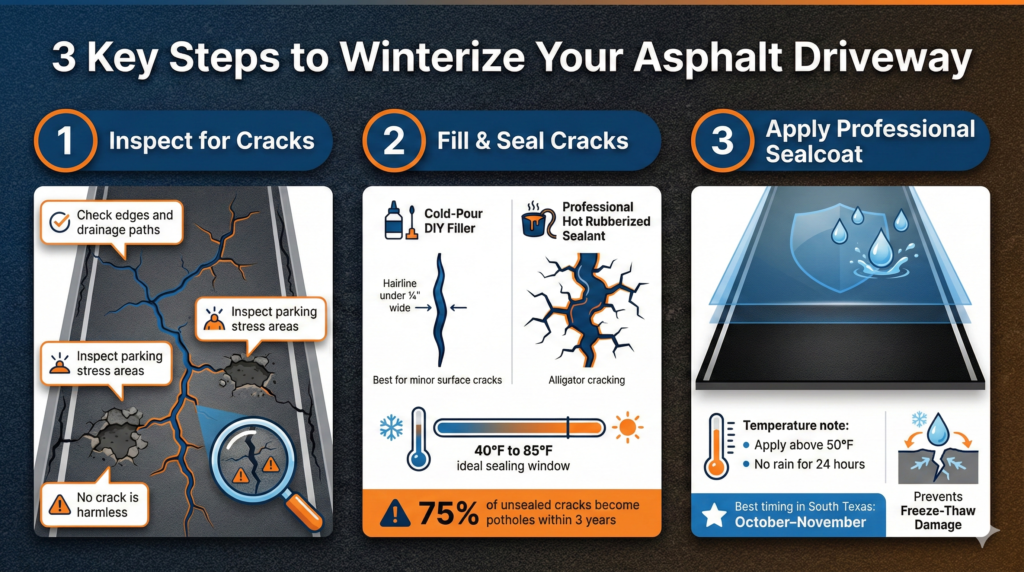
Walk your entire driveway on a dry afternoon and look for hairline cracks, larger fissures, potholes, or crumbling areas. Pay extra attention to edges, drainage paths, and spots where vehicles park regularly. Our guide to common types of asphalt cracking and their causes can help you identify what you’re seeing.
As Judd Burdon, President and CEO of Asphalt Kingdom with over 25 years of experience, explains: “There is no such thing as a harmless crack, no matter how small it seems, and given time, all cracks will continue to expand.”
Step 2: Fill and Seal All Cracks Before Temperatures Drop
For cracks narrower than a quarter inch, a quality cold-pour crack filler works as a DIY solution. For wider cracks or alligator-pattern cracking, a professional using hot-applied rubberized sealant delivers more durable results.
The ideal temperature for crack sealing is between 40 and 85 degrees Fahrenheit, making fall the perfect window in Texas. Data from Platinum Paving shows that 75% of unsealed cracks develop into potholes within three years.
Step 3: Apply a Professional Sealcoat
After cracks are repaired, a fresh sealcoat is the single most effective step to protect your asphalt from winter damage. It creates a waterproof barrier that prevents moisture penetration, which is exactly what drives freeze-thaw destruction.
Sealcoat must be applied when temperatures are consistently above 50 degrees Fahrenheit and no rain is expected for 24 hours. In South Texas, October or November offers the best window before winter.
How Does Sealcoating Protect Your Driveway Through Winter?
Sealcoating is the cornerstone of winter driveway protection. It creates a sealed surface layer that blocks water, UV rays, and chemical spills from reaching the asphalt binder underneath.
The Science Behind Sealcoating as a Winter Barrier
Sealcoating fills surface voids and micro-cracks that aren’t visible to the naked eye but still allow water to penetrate. Once sealed, your driveway repels moisture instead of absorbing it, which directly prevents freeze-thaw damage from gaining a foothold.
According to Bart’s Asphalt, properly maintained sealcoated driveways can last 20 to 30 years, while unsealed surfaces typically hold up for only 10 to 15 years. Regular sealcoating can add up to 20 extra years of service life.
Steven Brahney, an asphalt industry professional with more than 30 years of experience, notes through FixAsphalt.com that the quality of sealcoating application matters as much as the product itself. Cutting corners with diluted materials or single-coat applications often leaves the surface vulnerable to the damage sealcoating is meant to prevent.
For a deeper look at what sealcoating involves, visit our asphalt sealcoating guide.
When to Apply Sealcoat for Maximum Winter Protection
Timing your sealcoat application is critical. In South Texas, the ideal window falls between late September and mid-November, when daytime temperatures are reliably above 50 degrees but before the first freeze events of winter.
A few timing guidelines to keep in mind:
- New driveways should wait 6 to 12 months after installation before their first sealcoat.
- Existing driveways benefit from sealcoating every 2 to 3 years.
- Avoid sealcoating if rain is forecast within 24 to 48 hours.
Typical sealcoating costs range from $1.25 to $1.50 per square foot for professional application. For a standard two-car driveway of about 480 square feet, that translates to roughly $600 to $720, a modest investment compared to the $3 to $7 per square foot cost of full replacement.
For more on scheduling, check out our guide on sealcoating timing and frequency.
Drainage and Grading: Preventing Winter Water Damage
Standing water is one of the most destructive forces your asphalt driveway faces during winter. When water pools on the surface, it seeps into cracks, saturates the base layer, and sets the stage for freeze-thaw damage that undermines your driveway’s structure.
Signs of Poor Drainage on Your Asphalt Driveway
After a rainstorm, walk your driveway and look for these warning signs:
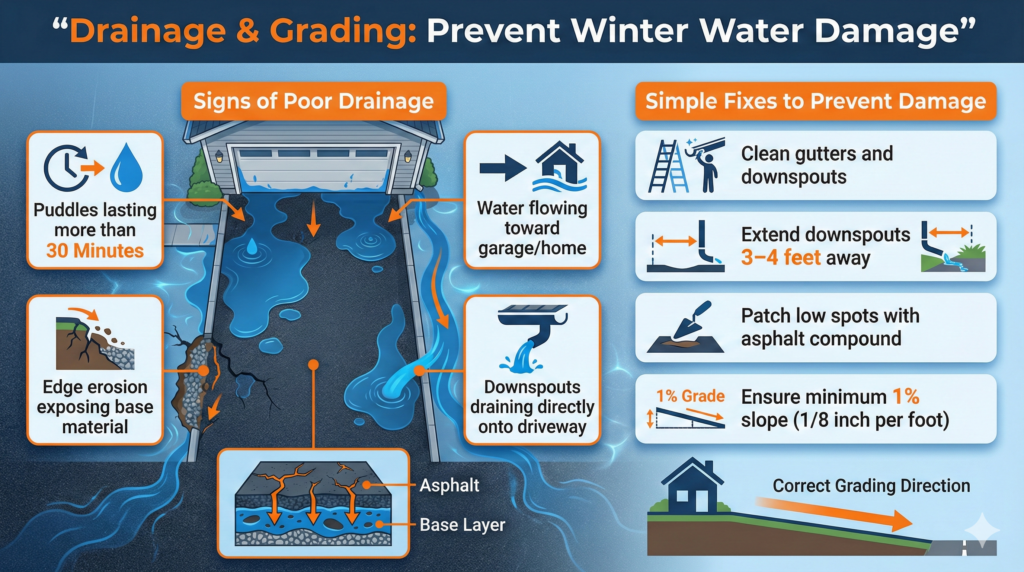
- Puddles remaining more than 30 minutes after rain stops indicate low spots or insufficient slope.
- Water flowing toward your garage or home instead of away from it signals a grading problem.
- Erosion along driveway edges where soil has washed away, exposing base material.
- Clogged gutters and downspouts dumping water directly onto the driveway surface.
Simple Fixes That Prevent Costly Winter Damage
Addressing drainage issues before winter is one of the most cost-effective maintenance steps you can take. Here’s what to focus on:
- Clear all gutters and downspouts so roof runoff flows away from your driveway.
- Redirect downspout extensions at least 3 to 4 feet from the driveway edge.
- Fill low spots with asphalt patching compound to eliminate pooling areas.
- Confirm the driveway slope directs water away from your home. A grade of at least 1% (1/8 inch per foot) is recommended.
For a comprehensive look at moisture protection, read our guide on how to prevent water damage on asphalt surfaces.
What De-Icers Are Safe for Asphalt Driveways in Texas?
When icy conditions hit South Texas, your first instinct may be to reach for rock salt. But not all de-icers are safe for asphalt, and some can accelerate deterioration rather than protect your driveway.
Products to Avoid on Asphalt Surfaces
Rock salt (sodium chloride) is the most common de-icer, but it’s corrosive to asphalt, breaks down the binder over time, and becomes ineffective below 15 degrees Fahrenheit.
Safer Alternatives That Protect Your Investment
| De-Icer | Safe for Asphalt? | Effective Temperature | Notes |
| Rock Salt (Sodium Chloride) | No | Above 15 degrees F | Corrosive to asphalt binder; damages vegetation |
| Calcium Chloride | Yes | Down to -25 degrees F | Less corrosive; works faster in extreme cold |
| Magnesium Chloride | Yes | Down to 0 degrees F | Gentle on asphalt; lower environmental impact |
| Calcium Magnesium Acetate (CMA) | Yes | Down to -25 degrees F | Biodegradable; safest option for pavement |
| Sand or Kitty Litter | Yes (traction only) | Any temperature | Does not melt ice; provides traction on slippery surfaces |
For most Texas homeowners, calcium magnesium acetate or magnesium chloride offer the best balance of performance and asphalt safety.
When Should You Call a Professional for Winter Driveway Prep?
While some winterization tasks are manageable as DIY projects, there are situations where a professional evaluation will save you significantly more money in the long run.
The Federal Highway Administration (FHWA) defines effective pavement preservation as “applying the right treatment to the right pavement at the right time.” That principle applies to residential driveways just as it does to highways.
Consider calling a professional if you notice:
- Cracks wider than a quarter inch or extensive alligator cracking
- Soft or spongy spots when you walk on the driveway
- Visible base material showing through the surface
- Drainage problems requiring grading corrections
- A driveway not sealcoated in more than 3 years
Industry studies show that every $1 invested in preventive maintenance saves $4 to $10 in future costs. One homeowner we worked with had a 20-year-old driveway showing severe cracking. We recommended strategic patching followed by professional sealcoating, extending the driveway’s life by 5 to 7 years at 60% cost savings compared to full replacement.
For more strategies, explore our guide on how to extend the lifespan of your driveway.
Protect Your Texas Driveway Before Winter Hits
Winterizing your asphalt driveway in Texas comes down to a few practical steps: inspect and repair cracks, apply a quality sealcoat, fix drainage issues, and use asphalt-safe de-icers. These actions cost a fraction of what emergency repairs or full replacement would demand after a damaging winter.
South Texas freeze-thaw cycles may be shorter than what northern states experience, but they can cause real, lasting damage to unprotected asphalt. Taking action in the fall gives your driveway the best chance of coming through winter strong and intact.
Ready to winterize your driveway the right way? Contact C. Brooks Paving for a free consultation. Our team serves Bulverde and the greater South Texas Hill Country region with professional sealcoating, crack repair, and driveway maintenance built to handle everything Texas weather throws your way.