Skip to content





Paving installation for a new home involves five core steps: site evaluation, grading and drainage planning, subbase preparation, surface material application, and compaction with curing. In South Texas, proper timing and base preparation are the most critical factors in building a driveway that lasts 20 to 30 years.
Key Takeaways
- A properly installed asphalt driveway can last 20 to 30 years with routine maintenance, while concrete surfaces can reach 30 to 40 years depending on climate and care.
- Subbase preparation is the single most important step in the paving process. Without a stable foundation, even the best surface material will crack and settle prematurely.
- New home driveway paving costs between $7 and $13 per square foot for asphalt installation, with the average project landing around $5,268 nationally.
- Timing your paving project correctly during construction protects your investment from damage caused by heavy equipment and delivery trucks.
- A paved driveway can add $5,000 to $7,000 to your property’s value and significantly boost curb appeal.
What Does Paving Installation for a New Home Involve?
Paving installation for new construction is a multi-phase process that transforms raw land into a durable, weather-resistant surface. Unlike repaving an existing driveway, new home paving starts from the ground up.
Site Evaluation and Soil Assessment
Before any equipment arrives, a professional paving contractor evaluates the property’s soil conditions, slope, and drainage patterns. This step is essential in South Texas, where clay-heavy soils and extreme heat create unique challenges.
According to Ruston Paving, paving on a soft subgrade leads to inconsistent compaction, uneven surfaces, and premature cracking. In the Bulverde and Hill Country area, soil conditions vary widely from lot to lot, making a thorough site evaluation non-negotiable.
“The subgrade is extremely essential, as it is the foundation of the pavement. It should be free of topsoil and vegetation and must be well compacted,” notes EastCoat Pavement Services, a paving industry resource on subgrade best practices.
If you’re planning for a site grading contractor for new builds, coordinating with your paving team early ensures the grading supports long-term performance.
Grading, Drainage, and Base Preparation
After the soil assessment, the site is graded to establish proper slope and water flow. A well-graded driveway should slope approximately 1/4 inch per foot, directing water away from your home’s foundation.
According to the Federal Highway Administration, proper paving techniques can extend pavement lifespan by up to 30%. Much of that performance starts at the grading and base preparation stage.
What Are the Steps in the Paving Installation Process?
The paving installation process follows a logical sequence. Each step builds on the one before it, and cutting corners at any stage compromises the entire surface.
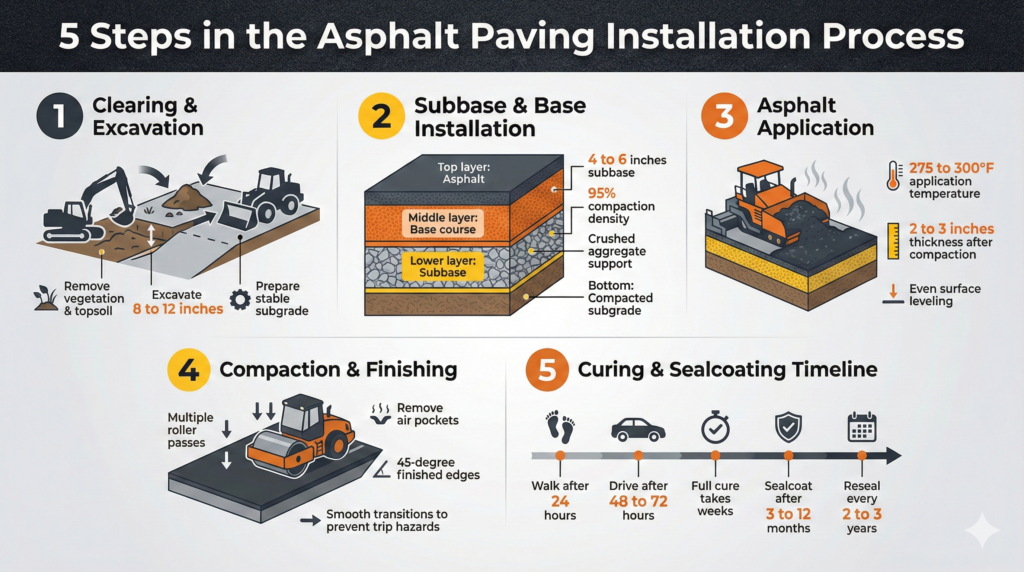
Step 1: Clearing and Excavation
The first step involves clearing the driveway footprint of all vegetation, topsoil, and debris. Heavy equipment like bobcats and small excavators remove loose material down to stable subgrade, typically 8 to 12 inches deep to accommodate the subbase and surface layers.
Step 2: Subbase and Base Course Installation
The subbase is a layer of crushed aggregate placed on top of the prepared subgrade. It serves as the structural backbone of your driveway. According to Pavement Interactive, the subbase functions primarily as structural support while preventing fine soil particles from migrating into the pavement layers above.
For residential driveways, the subbase is typically 4 to 6 inches thick and must be compacted in layers to achieve at least 95% compaction density. The base course, made from crushed stone, is installed on top using a similar process to distribute vehicle weight evenly and prevent surface deformities.
Step 3: Asphalt or Surface Material Application
With a stable base in place, the surface material is applied. For asphalt driveways, hot-mix asphalt is delivered at 275 to 300 degrees Fahrenheit and spread using a paving machine, then leveled for an even surface.
Residential asphalt driveways are typically 2 to 3 inches thick after compaction. This is often the quickest step in the process, sometimes taking just one hour for smaller projects, but it depends entirely on the preparation work that came before it.
Step 4: Compaction and Finishing
Immediately after the surface material is laid, heavy rollers make multiple passes to compact the asphalt and eliminate bumps, air pockets, and irregularities. According to William Stanley & Sons Paving, compaction is the most important step in the process because without it, air gaps allow water to seep in and weaken the asphalt from within.
Edges are finished at a 45-degree angle, and transitions between the new driveway and existing surfaces are smoothed to prevent trip hazards.
Step 5: Curing and Sealcoating Timeline
After installation, asphalt needs time to cure. You can typically walk on it after 24 hours and drive on it after 48 to 72 hours, but full curing takes several weeks depending on weather.
Sealcoating should not be applied until 3 to 12 months after installation. Applying sealant too early interferes with curing. Once cured, sealcoating every 2 to 3 years protects against UV damage, water infiltration, and oxidation, especially important in the South Texas heat.
For a detailed look at each phase, our guide on the asphalt paving process for Texas properties covers what to expect.
When Should You Schedule Paving During New Home Construction?
Timing your driveway paving correctly during the construction process is one of the smartest decisions you can make. Getting it wrong can mean costly damage or a surface that doesn’t hold up.
Why Timing Matters for Durability
The biggest risk of paving too early is damage from construction traffic. Concrete trucks, lumber deliveries, and heavy equipment can crack or crush a newly paved surface.
A practical approach: install the gravel subbase early in the construction timeline and let heavy trucks compact it naturally over weeks. Then, once major construction wraps up, bring in your paving contractor to lay the final surface on a well-settled base.
Coordinating with Your Builder and Paving Contractor
Communication between your home builder and paving contractor is essential. Make sure underground utilities are installed before grading begins, that the builder’s grading supports proper drainage, and that paving is scheduled as one of the last exterior projects.
In South Texas, the best paving conditions occur during warmer months (March through November), when asphalt can be properly heated, applied, and compacted.
How Much Does Driveway Paving Cost for New Construction?
Understanding the cost of driveway paving helps you budget accurately. Prices vary based on material, size, and site conditions.
Cost Breakdown by Material
| Material | Cost per Sq Ft (Installed) | Lifespan | Best For |
| Asphalt | $7 to $13 | 15 to 30 years | Cost-effective durability, flexible in heat |
| Concrete | $10 to $15 | 30 to 40 years | Long-term performance, decorative options |
| Chip Seal / Tar and Chip | $3 to $6 | 7 to 12 years | Rural properties, ranch driveways |
| Interlocking Pavers | $18 to $25 | 30 to 50+ years | Premium aesthetics, design flexibility |
For a standard 600-square-foot residential driveway, homeowners can expect to pay between $3,600 and $5,400 for asphalt and $6,000 to $9,000 for concrete. Larger or more complex layouts with curves or slopes can add 15% to 30% to labor costs.
Factors That Affect Your Final Price
Several variables influence the total cost. Site preparation (excavation, grading, soil stabilization) can add $1 to $3 per square foot. Curved or multi-turn layouts add 15% to 30% in labor costs. Geographic location affects material availability and labor rates, and in South Texas, heat-resistant mixes may be recommended.
Getting quotes from multiple licensed contractors helps you compare effectively. For help choosing the best driveway material for your home, our full guide breaks down the pros and cons of each option.
What Driveway Material Is Best for a New Home in Texas?
Choosing the right material depends on your budget, aesthetic preferences, and maintenance tolerance. In the South Texas climate, heat resistance and drainage are top priorities.
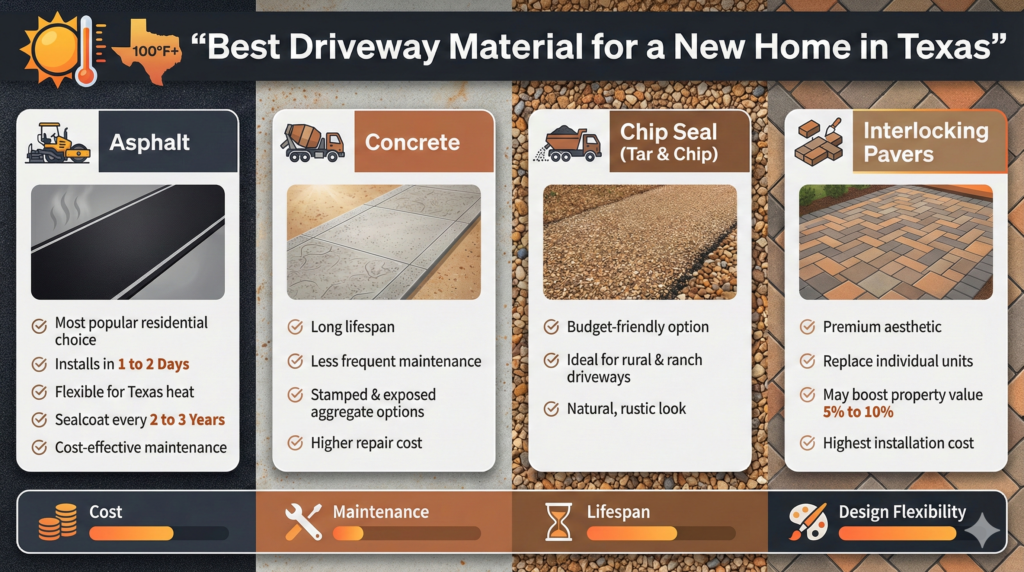
Asphalt is the most popular choice for residential driveways. It’s cost-effective, quick to install (often 1 to 2 days), and flexible enough to handle temperature swings. It requires sealcoating every 2 to 3 years, but routine maintenance keeps costs low.
Concrete offers a longer lifespan and less frequent maintenance. Modern decorative options like stamping and exposed aggregate allow customization, though repairs tend to be more expensive than asphalt.
Chip seal (tar and chip) provides a cost-effective, textured option ideal for rural properties and ranch driveways in the Hill Country.
Interlocking pavers are the premium choice, offering design flexibility and the potential to boost property values by 5% to 10%. Individual pavers can be replaced if damaged, but installation costs are significantly higher.
How Does a Paved Driveway Increase Your Home’s Value?
A paved driveway isn’t just functional. It’s one of the most visible improvements you can make to a new home, and it directly impacts how buyers perceive your property.
Curb Appeal and Resale Impact
A paved driveway can add $5,000 to $7,000 to your home’s value, with some markets seeing even higher returns. Morris Lucas, a top-selling real estate agent in Indianapolis, notes that a well-maintained driveway could add $10,000 to $20,000 to property value in certain markets.
Real estate professionals report that 76% of agents identify curb appeal as the primary factor influencing sale price. Research also shows that paving can increase your home’s value by up to 8%, making it one of the most cost-effective exterior improvements for new construction.
Start Your New Home Paving Project the Right Way
Building a new home is a major investment, and your driveway deserves the same level of planning and quality as the rest of the property. A properly installed driveway protects your foundation from water damage, provides safe access for your vehicles, and adds real value from day one.
The key takeaway: invest in proper site evaluation, don’t rush subbase preparation, choose the right material for your climate and budget, and work with an experienced contractor who understands South Texas conditions.
Ready to plan your new home’s driveway? Contact C. Brooks Paving for a free consultation. Our team has generations of experience helping homeowners across Bulverde and the Hill Country build driveways that perform for decades.