Skip to content





For long driveways in Bulverde and the South Texas Hill Country, chip seal costs 30-40% less upfront at $2 to $5 per square foot, while asphalt runs $6 to $9 per square foot but lasts two to three times longer. Over 20 years, asphalt typically delivers a lower total cost per year for driveways with regular use. The right choice depends on your budget, timeline, and maintenance preferences.
This guide covers installation costs, lifespan, maintenance, and total ownership costs for both surfaces. For a broader look at options, see our guide on choosing the best driveway material.
Key Takeaways
- Chip seal saves upfront, asphalt saves long-term. Chip seal installation costs 30-40% less, but asphalt driveways last 20-25 years compared to chip seal’s 7-10 years, often making asphalt the more cost-effective investment over time.
- 20-year cost gap is real. For a 2,000 sq ft long driveway, asphalt’s total 20-year cost comes to roughly $18,000-$22,500, while chip seal totals $16,000-$25,000 after two to three full reapplications.
- Texas heat hits both surfaces hard. Asphalt surface temperatures in South Texas reach 150-152°F at midday (per a pilot study cited by the EPA), accelerating oxidation. Chip seal aggregate holds up slightly better under UV but still needs regular reapplication.
- Maintenance makes or breaks your investment. According to the National Asphalt Pavement Association (NAPA), regular sealcoating can double asphalt pavement lifespan. Skipping maintenance on either surface shortens its life dramatically.
How Do Asphalt and Chip Seal Compare for Long Driveways?
Both asphalt and chip seal are popular for long driveways in the Texas Hill Country, but they differ significantly in composition, performance, and total cost. Understanding these differences helps you make the best decision for your property.
What Is Asphalt Paving?
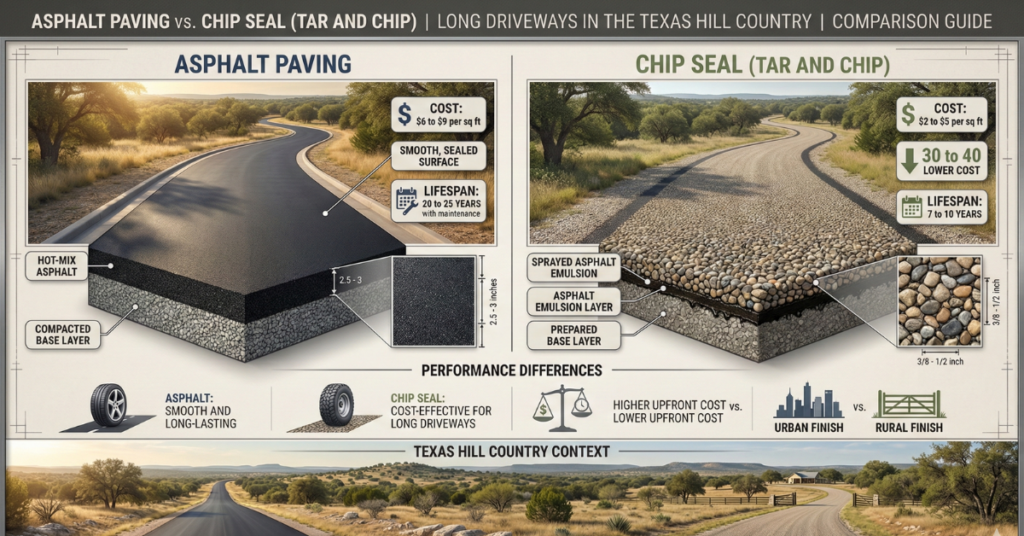
Asphalt paving (hot-mix asphalt) involves laying a heated mixture of aggregate, sand, and petroleum-based binder over a compacted base, creating a smooth, sealed surface. Industry data from Today’s Homeowner puts cost at $6-$9 per square foot, with a 20-25 year lifespan when maintained. For details, read our complete guide to asphalt paving in South Texas.
What Is Chip Seal (Tar and Chip)?
Chip seal (tar and chip) involves spraying hot asphalt emulsion onto a prepared base, then spreading and rolling crushed stone into it. It creates a textured, gravel-like surface popular for rural roads. Learn more about chip seal driveways for rural roads. It costs $2-$5 per square foot (30-40% less than asphalt), with a typical lifespan of 7-10 years.
Asphalt vs Chip Seal Cost Breakdown for Long Driveways
Cost is often the deciding factor when comparing asphalt vs chip seal for long driveways. Here’s how the numbers break down for a typical long driveway in the Bulverde, TX area.
Upfront Installation Costs
For a 2,000-square-foot driveway (common for longer Hill Country properties), initial costs break down as follows:
- Chip seal: $4,000-$10,000 ($2-$5/sq ft). Range depends on stone type and base condition.
- Asphalt: $12,000-$18,000 ($6-$9/sq ft). Varies by thickness and base prep requirements.
On a 2,000 sq ft driveway, chip seal could save you $8,000 or more at installation. But the upfront cost is only part of the picture.
Long-Term Maintenance Costs
Rob Vance, VP of Sales at Vance Brothers and former PCTC chairman, notes that sealcoating slows degradation of hot-mix asphalt, extending the time before major repairs are needed.
Asphalt maintenance includes sealcoating every 2-3 years ($0.15-$0.25/sq ft) plus crack filling at $1-$4 per linear foot. NAPA data shows regular sealcoating can double pavement lifespan. Over 20 years, expect $3,000-$6,000 in maintenance for a 2,000 sq ft driveway.Chip seal maintenance involves periodic sweeping and full reapplication every 7-10 years at $2-$5 per square foot. Over 20 years, two to three reapplications add $8,000-$20,000, not counting minor patching.
Side-by-Side Cost and Performance Comparison
| Factor | Asphalt | Chip Seal |
| Installation Cost (per sq ft) | $6 – $9 | $2 – $5 |
| 2,000 Sq Ft Driveway Install | $12,000 – $18,000 | $4,000 – $10,000 |
| Expected Lifespan | 20 – 25 years | 7 – 10 years |
| Maintenance Cycle | Sealcoat every 2-3 years | Reapply every 7-10 years |
| 20-Year Maintenance Cost | $3,000 – $6,000 | $8,000 – $20,000 |
| Est. 20-Year Total Cost | $18,000 – $22,500 | $16,000 – $25,000 |
| Surface Finish | Smooth, sealed | Textured, gravel-like |
| Best For | Daily-use, long-term homes | Budget-focused, rural, shorter-term |
How Long Does Each Surface Last in the Texas Hill Country?
Lifespan is where the asphalt vs chip seal comparison gets especially important for long driveways in the Hill Country. The intense South Texas climate puts unique pressure on both surfaces.
Asphalt Lifespan and Durability
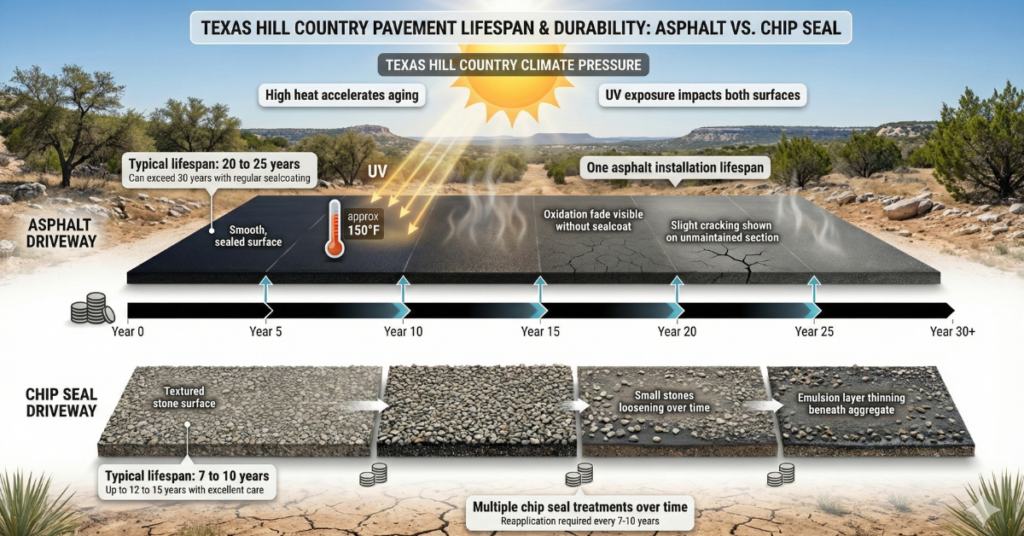
A well-installed asphalt driveway lasts 20 to 25 years with consistent maintenance. Alpha Paving Industries (Austin, TX) reports that many home driveways perform well beyond 30 years when sealcoated on schedule.
A pilot study cited by the U.S. EPA found conventional asphalt reaches 152°F at midday in hot climates. In South Texas, UV radiation accelerates oxidation, making the surface brittle and crack-prone. Without sealcoating, deterioration accelerates significantly.
Chip Seal Lifespan and Reapplication Schedule
Chip seal driveways have a shorter lifespan. Industry sources put it at 7-10 years for properly applied surfaces, with some pushing to 12-15 years under excellent maintenance.
In Hill Country heat, chip seal aggregate loosens as emulsion ages. Reapplication every 7-10 years is essential, meaning two to three full treatments within the span of a single asphalt installation’s lifespan.
What Are the Maintenance Requirements for Each Option?
Both asphalt and chip seal need ongoing care, but the type and frequency differ significantly. Here’s what each option requires on a long driveway.
Asphalt Maintenance: Sealcoating and Crack Repair
Jeff Luzar, Division Manager at GuardTop, notes that new asphalt needs time for oils to oxidize before sealcoating. But if too many oils escape, the surface turns brittle. The key is sealcoating before that tipping point, then every 2-3 years after.
- Sealcoating every 2-3 years to block UV rays and slow oxidation. This is critical in South Texas. See our guide on sealcoating timing and frequency.
- Crack filling as needed at $1-$4 per linear foot to prevent water damage to the base layer.
- Drainage management to prevent standing water, a leading cause of premature failure.
- Twice-yearly inspections to catch small issues before they become expensive.
Research from the National Center for Asphalt Technology (NCAT) found that sealcoated pavements lasted up to 50% longer than unsealed ones. For more, visit our resource on how to extend the lifespan of your driveway.
Chip Seal Maintenance: Reapplication and Sweeping
- Regular sweeping to clear loose stones, leaves, and debris that trap moisture.
- Prompt crack and pothole repair to prevent water infiltration from undermining the base layer.
- Full reapplication every 7-10 years at $2-$5 per square foot, which is the largest recurring expense for chip seal driveways.
Chip seal’s advantage is that individual tasks are straightforward. The disadvantage is that full reapplication costs add up quickly on a long driveway where you’re treating a large surface each time.
Which Option Saves You More Over 20 Years?
When homeowners compare asphalt vs chip seal for long driveways, the real question is about total cost over time, not just what’s cheapest today. Here’s a realistic 20-year scenario for a 2,000 sq ft driveway in the Bulverde area.
20-Year Cost Comparison Scenario
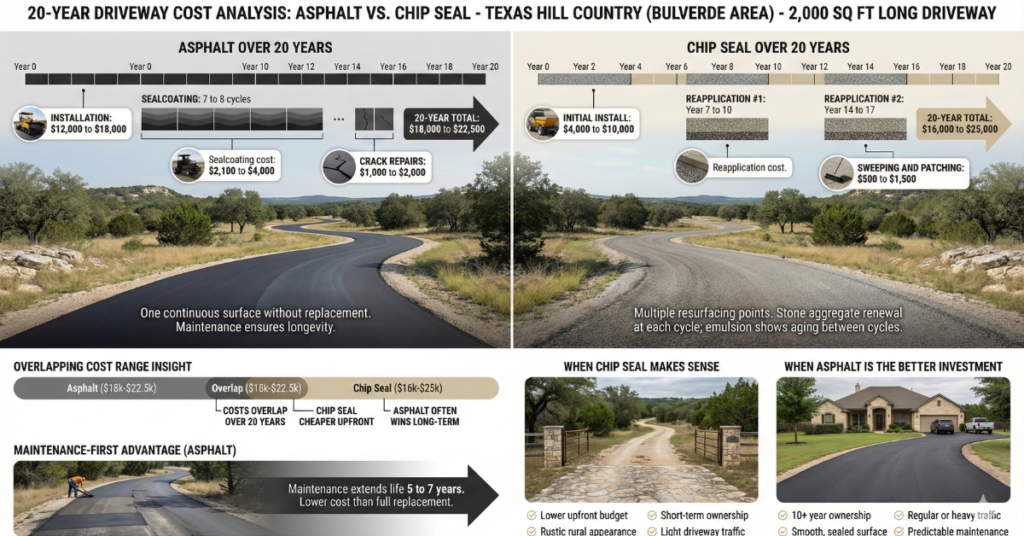
Asphalt (one installation + maintenance):
- Installation: $12,000-$18,000
- Sealcoating (7-8 cycles): $2,100-$4,000
- Crack repairs: $1,000-$2,000
- 20-year total: $18,000-$22,500
Chip seal (2-3 installations + maintenance):
- Initial installation: $4,000-$10,000
- Reapplication #1 (year 7-10): $4,000-$10,000
- Reapplication #2 (year 14-17): $4,000-$10,000
- Sweeping/patching: $500-$1,500
- 20-year total: $16,000-$25,000
The ranges overlap, which is the point. At the low end, chip seal can be more affordable. At the high end (especially with three full reapplication cycles), asphalt often wins on a cost-per-year basis.
When Chip Seal Makes More Sense
Chip seal makes sense when:
- Tight upfront budget. If $12,000+ isn’t feasible, chip seal gets your driveway paved for a fraction of the cost.
- Shorter-term ownership. If you’ll sell within 5-7 years, chip seal provides a functional surface without overinvesting.
- Rustic aesthetic preference. Chip seal’s natural stone finish blends with rural Hill Country properties.
- Light driveway traffic. Low-traffic use puts less stress on chip seal, helping it reach the upper end of its lifespan.
When Asphalt Is the Better Investment
Asphalt tends to be the better investment when:
- You plan to stay 10+ years. The longer you stay, the more value you get from asphalt’s extended lifespan without needing full replacement.
- Your driveway sees regular or heavy traffic. Multiple vehicles, delivery trucks, or trailers stress a surface, and asphalt handles that load better.
- You value a smooth, sealed surface. Asphalt offers a cleaner finish with less loose aggregate, boosting curb appeal.
- You prefer predictable maintenance. One installation plus periodic sealcoating is simpler than managing multiple chip seal reapplications.
One Bulverde homeowner we worked with chose strategic patching and sealcoating on a 20-year-old asphalt driveway instead of full replacement, gaining 5-7 more years at 60% of replacement cost. That maintenance-first approach is a key asphalt advantage that chip seal can’t match.
Ready to Pave Your Long Driveway? Let C. Brooks Paving Help
Choosing between asphalt and chip seal for a long driveway comes down to your budget, timeline, and how you use your property. Both surfaces have a place in the Bulverde and Hill Country market.
At C. Brooks Paving, we help homeowners across Bulverde and the greater South Texas region make informed decisions about driveway paving. Whether you’re leaning toward asphalt for its durability or chip seal for its upfront savings, we’ll evaluate your property and recommend the surface that fits your needs.
Contact C. Brooks Paving today for a free driveway consultation. We’ll assess your property, discuss your goals, and provide a clear, honest estimate so you can move forward with confidence.