 Skip to content
Factory Access Road Paving for the Texas Hill Country & Central Texas
Professional factory access road paving services by C. Brooks Paving. Built to withstand heavy equipment and Texas weather. Get a durable solution for your facility.













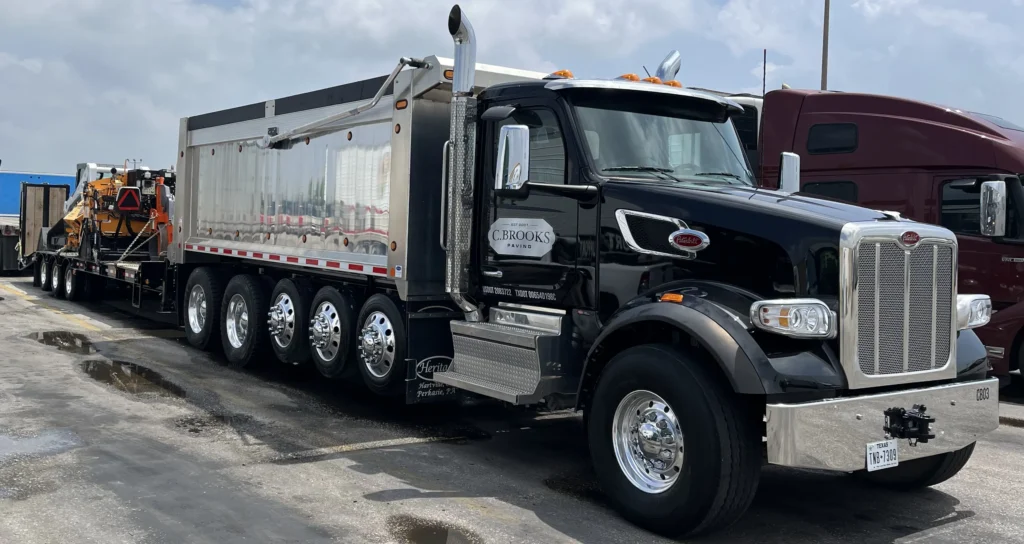
Industrial-Grade Factory Floor Access Roads for Texas Manufacturing Facilities
Access roads at manufacturing and industrial facilities are more than connectors between a public road and a building entrance. They are the backbone of every facility’s operation, carrying inbound raw materials, outbound finished goods, daily vehicle traffic, and the movement of heavy equipment that keeps the plant running. A failed access road isn’t a maintenance inconvenience. It’s a bottleneck. Delivery trucks that can’t navigate a potholed entrance ramp cause scheduling delays. Forklift travel paths with deteriorated edges cause equipment damage and create OSHA-documented trip and fall hazards for workers moving between the facility and yard areas.
Manufacturing and industrial operations across the Texas Hill Country and Central Texas face access road challenges that general contractors don’t anticipate. Facilities in limestone terrain deal with subsurface irregularity that causes differential settlement beneath access road surfaces, uneven settling that creates surface breaks at specific points even on a recently paved road. Texas summer heat affects binder performance on surfaces that sit in full sun without shade cover, and the frequency of heavy inbound truck traffic on a single entry lane concentrates load repetitions far beyond what a standard road cross-section can handle. According to the Occupational Safety and Health Administration, surface condition on industrial access routes and yard areas is a workplace safety compliance factor, deteriorated surfaces that create trip hazards or unstable footing for workers constitute a recordable condition.
Brooks Paving serves manufacturing plants, processing facilities, oil field service yards, construction equipment campuses, and industrial operations throughout the Texas Hill Country, Central Texas, and South Texas from our Bulverde base. We assess access road conditions during a free site visit, identifying load concentration zones, drainage problems, sub-grade issues, and transition conditions at door approaches, and produce a written estimate that addresses each condition specifically. Factory entrance paving, internal plant road connections, door approach transitions, and oil field access surfaces are all part of what we build and maintain.
Specialized Access Road Solutions for Industrial Settings
Each factory works differently. Traffic patterns, surface wear, and site needs change from one facility to another. That’s why we build custom solutions to match your real operations.
HEAVY-DUTY ASPHALT PAVING
Heavy-Duty Asphalt Paving for Factory Entrances and Internal Roads
Factory access roads carry a load profile that standard commercial paving specs don't account for: daily semi-truck traffic at up to 80,000 lbs gross vehicle weight, often on a single lane entry that concentrates every load at the same tire paths. The Federal Highway Administration's pavement design standards identify repeated heavy axle loads as the primary pavement fatigue mechanism, each pass at 80,000 lbs causes more structural damage than hundreds of passenger vehicle passes. Factory entrance roads, dock approach ramps, and internal facility roads connecting buildings on a manufacturing campus require base depths and mix specifications designed around the actual heaviest vehicle that will use the surface, not an average load estimate.
We design and specify each zone of a factory access road project separately, the entrance from the public road, the internal circulation lanes, the dock approach surfaces, and the employee parking connector. Each zone carries different loads and deserves a different specification. The result is a paved surface that holds up under actual operating conditions rather than deteriorating at the highest-load zones within the first few years. See our heavy-duty asphalt paving page for detail on base depth and mix specifications for industrial load conditions.
HYBRID SOLUTIONS FOR COMPLEX FACILITIES
Hybrid Paving Solutions for Complex Facility Footprints
Not every surface zone at a manufacturing or industrial facility requires the same specification, and designing the entire site to the highest load creates unnecessary cost. A hybrid approach specifies hot-mix asphalt at the entrance road, dock approaches, and heavy vehicle circulation lanes, while using chip seal on lower-volume internal service roads, perimeter access routes, and oil field or remote facility access corridors where full hot-mix isn't operationally necessary.
Chip seal (tar and chip) performs well on lower-volume industrial access roads throughout Central and South Texas, it provides a stable, dust-controlled surface, handles the region's temperature range well, and costs significantly less per lane-mile than full hot-mix construction. For oil field service yards and remote equipment staging areas, chip seal on a well-prepared base is often the right call. The Asphalt Pavement Alliance identifies surface type selection based on traffic classification and load profile as the foundation of long-term pavement cost efficiency, we apply that principle to every multi-zone industrial facility scope we estimate. See our chip seal paving page for where chip seal fits into industrial facility road planning.
WHY TEXAS MANUFACTURERS TRUST C. BROOKS PAVING

A+ BBB Accredited
Accredited with the Better Business Bureau and maintaining an A+ rating since our founding.
Owner on Every Job Site
Courtnay Brooks is present at every project. You’re not handing your property over to a subcontractor.
All Work Guaranteed in Writing
Every estimate and every job is documented. No verbal promises. No hidden charges.
State-of-the-Art Equipment
We run Etnyre, Bear Cat, and Leeboy equipment, some of the best chip seal and asphalt machinery available in the region.

C. Brooks Industrial Paving Process
Free Estimate & Site Visit
We’ll come out, look at the project, and give you a clear price.
Proposal
We will gather all the information and provide you with a detailed scope of the project that fits within your budget and timeline
Construction
The work is scheduled and construction begins while you are kept in the loop every step of the way
Free Estimate & Site Visit
We’ll come out, look at the project, and give you a clear price.
Proposal
We will gather all the information and provide you with a detailed scope of the project that fits within your budget and timeline
Construction
The work is scheduled and construction begins while you are kept in the loop every step of the way
Factory Access Road FAQ
How long should factory access roads last in Texas?
A properly specified factory access road, adequate base depth for the actual load profile, correct performance-graded binder for Texas temperature conditions, and positive drainage away from the roadway, should perform for 20-25 years before major rehabilitation is needed. The Asphalt Pavement Alliance cites correct base specification as the single largest factor in industrial pavement longevity. Access roads that fail in 5-8 years are almost always a design problem — standard commercial specs applied to industrial loads, rather than an asphalt quality problem. We design to the actual load and document the specification in the written estimate.
Can you pave around our operating schedule?
Yes. Factory access road projects require sequencing around your facility’s operating hours, inbound delivery schedule, and shift patterns. A main entrance that has to stay open during first and second shift can still be paved, we work in sections or schedule lane closures during shift transitions or low-traffic windows. We review your operating schedule during the estimate process and build phasing into the written proposal, so you know before we start which sections will be restricted on which days. Most factory access road projects, entrance, dock approaches, and internal roads, can be sequenced to keep the facility operational throughout construction.
Do you pave oil field access roads and service yard surfaces?
Yes. Oil field service yards and remote access roads across South and Central Texas are part of our industrial paving scope. These applications often call for a hybrid approach: chip seal or cold mix on low-volume access corridors leading to the site, and hot-mix asphalt at the yard itself where equipment staging, truck loading, and service vehicle traffic concentrates. We assess the access route condition, the yard footprint, and the heaviest expected load during the site visit and specify each zone accordingly. Our team is familiar with the remote site logistics and variable sub-grade conditions common to oil field access road applications in South Texas.
What causes factory access roads to fail faster than expected?
The most common cause is specification mismatch, standard commercial paving specs applied to surfaces that carry industrial loads. A commercial parking lot spec uses 4-6 inches of base; a factory entrance road seeing daily 80,000 lb semi-truck traffic needs 8-12 inches. When the base is undersized, the pavement deflects under heavy axle loads, the base gradually consolidates, and the surface above develops fatigue cracks and eventually potholes at the highest-load zones. The second most common cause is drainage failure, water that ponds on the surface or saturates the base from poor edge drainage. We assess both factors during the site visit before specifying anything.
Can you handle the site grading and drainage before paving?
Yes. Site grading, establishing the surface slope to direct runoff away from the road surface and facility buildings, and drainage preparation are part of our scope on most factory access road projects. A factory access road with no cross-slope or positive drainage toward a ditch or catch basin will accumulate standing water that infiltrates surface cracks, degrades the base, and creates icy conditions during winter freeze events. We handle sub-grade assessment, rough and finish grading, drainage channel preparation, and culvert placement as part of the complete project scope. See our site grading and excavation page for detail on what we handle before paving begins.
What is the difference between a factory access road and a private road?
The distinction is primarily in load design and operational context. A private road, serving a residence or ranch, carries passenger vehicles, occasional delivery trucks, and light equipment. Design spec centers on surface stability and dust control, with base depths appropriate for light loads. A factory access road carries repeated heavy axle loads from semi-trucks, forklifts moving between the building and the yard, and construction or service equipment that may operate on the surface during facility maintenance. It requires heavier base depth, higher-stability hot-mix asphalt at dock approach areas, and drainage designed for an impervious surface at an active industrial facility. The site visit and written estimate reflect that distinction, we don’t apply a private road spec to an industrial entrance.
What is the difference between a factory access road and a private road?
The distinction is primarily in load design and operational context. A private road, serving a residence or ranch, carries passenger vehicles, occasional delivery trucks, and light equipment. Design spec centers on surface stability and dust control, with base depths appropriate for light loads. A factory access road carries repeated heavy axle loads from semi-trucks, forklifts moving between the building and the yard, and construction or service equipment that may operate on the surface during facility maintenance. It requires heavier base depth, higher-stability hot-mix asphalt at dock approach areas, and drainage designed for an impervious surface at an active industrial facility. The site visit and written estimate reflect that distinction, we don’t apply a private road spec to an industrial entrance.
Do you serve manufacturing facilities outside of Bulverde and the Hill Country?
Yes. We serve manufacturing facilities, industrial yards, oil field service operations, and construction equipment campuses throughout 25 communities across the Texas Hill Country, Central Texas, and South Texas. From Fredericksburg and Kerrville in the Hill Country to Pleasanton, Carrizo Springs, and Cuero in South Texas, our team travels to industrial sites within our standard service area with no fuel surcharge. See the full list of communities we serve on our service areas page.
Serving Manufacturing Facilities Across Texas
- We proudly serve: