 Skip to content
Heavy-Duty Asphalt Paving for Industrial Texas Hill Country & Central Texas
Trust C. Brooks Paving for industrial-strength asphalt surfaces built to withstand Texas conditions. Our heavy-duty paving solutions deliver lasting performance across the Hill Country.













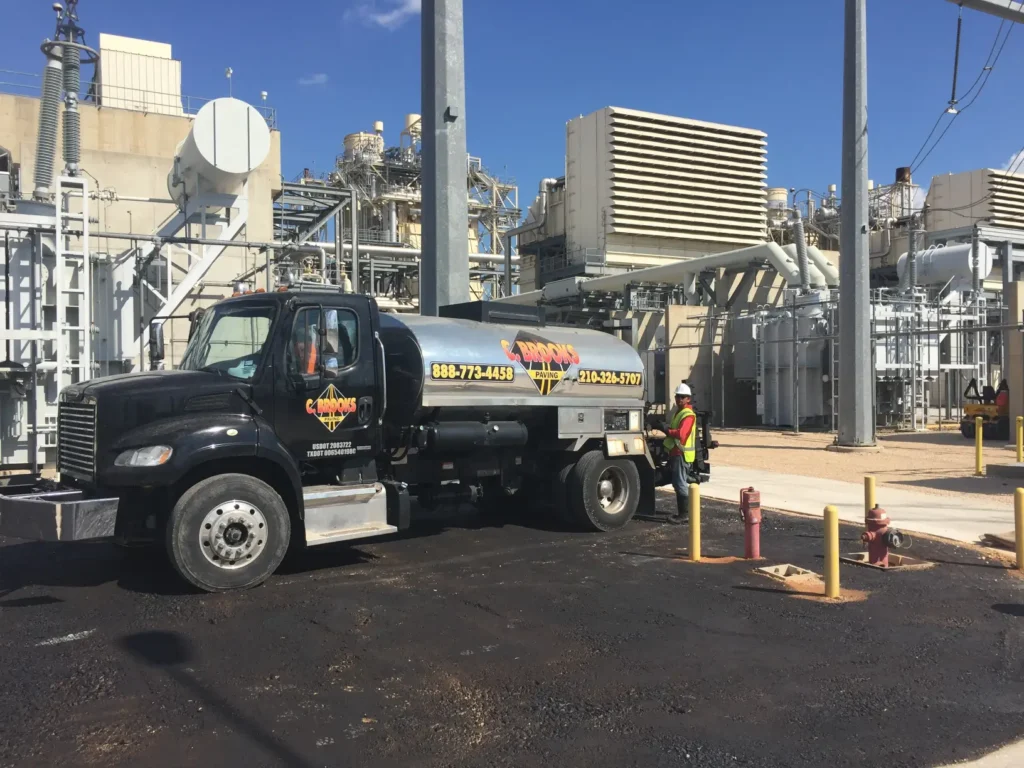
Heavy-Duty Asphalt Paving Solutions in Bulverde and the Texas Hill Country
Standard commercial asphalt fails under industrial loads, not because asphalt is the wrong material, but because it was specified for the wrong application. A loading dock apron that receives daily semi-truck traffic at 80,000 lbs gross vehicle weight needs a fundamentally different base depth, mix design, and sub-grade preparation than a parking lot built for passenger cars. When a contractor applies standard commercial specs to an industrial surface, the pavement begins failing within 2-5 years, rutting under fixed load points, alligator cracking in drive-through queues, edge failure along equipment staging areas. The repair cycle that follows costs far more than a correctly specified surface would have cost to build.
Heavy-duty asphalt paving is defined by its structural design, not just its surface appearance. The Asphalt Institute’s mix design specifications establish performance-graded binder selection based on temperature extremes and traffic loading conditions, in Central Texas industrial applications, both factors are at the high end. Surface temperatures on unshaded industrial yards routinely exceed 140°F in summer, and loads from fully loaded haul trucks, front-end loaders, and forklifts operate at weight-per-axle ratios that require deeper base courses and higher-stability hot-mix to resist permanent deformation. We design for the actual loads your facility generates, not a generic industrial estimate.
Brooks Paving serves manufacturing facilities, logistics and trucking operations, aggregate yards, construction equipment yards, and industrial campuses throughout the Texas Hill Country, Central Texas, and South Texas from our Bulverde base. Every heavy-duty paving project begins with a site visit to assess sub-grade condition, identify load concentration zones, and evaluate drainage, followed by a written estimate that specifies base depth, mix design, and scope by zone. No surprises, no generic specifications, no subcontracted crews.
Heavy-Duty Applications We Specialize In
Our paving services are built for environments that demand more. We build asphalt systems for sites that can’t afford downtime, repair, or weak pavement.
MANUFACTURING AND INDUSTRIAL FACILITIES
Manufacturing and Industrial Facility Paving
Manufacturing campuses generate a concentrated combination of load types that standard paving design doesn't account for. Heavy fork truck traffic, typical industrial sit-down forklifts run at 15,000-20,000 lb loaded capacity, applies significant point loads on a relatively small tire contact patch, creating high pressure-per-square-inch at specific travel paths. Outbound truck staging areas carry the full gross vehicle weight of loaded semi-trucks at fixed stop positions where the load is stationary rather than rolling. Overhead crane access pads and equipment placement zones carry concentrated static loads during installation and servicing. The Federal Highway Administration identifies static and slow-moving heavy loads as the most damaging pavement loading condition per pass, we spec base depth and mix stability at manufacturing sites accordingly. Each load zone is assessed separately and receives the appropriate structural design.
TRUCKING AND LOGISTICS YARDS
Trucking and Logistics Yard Paving
Logistics and trucking yards in Central and South Texas deal with a pavement condition that parking lot specs never contemplate: repeated full-weight truck loads at the same turning radii and the same dock apron positions, day after day, year-round. The combination of 80,000 lb gross vehicle weight, slow maneuvering speeds through tight turning patterns, and Texas summer surface temperatures creates a shear stress profile at dock aprons and turning areas that exceeds what standard hot-mix asphalt binders are designed to resist. The result is pavement shoving, the surface deforms laterally under slow heavy loads, and rutting at dock entry points that creates drainage problems and edge damage. We specify modified binder mixes for these locations and design dock apron depths at levels appropriate for the actual load cycle, not the statistical average. See our industrial park paving page for campus-scale logistics facility scopes.
QUARRY, MINING, AND CONSTRUCTION OPERATIONS
Quarry, Aggregate Yard, and Construction Operations
Aggregate operations in the Texas Hill Country present some of the most demanding paving conditions in the region. Haul trucks operating at 80,000-100,000 lbs move over paved surfaces multiple times daily, and the abrasive nature of aggregate materials, dropped during loading, tracked by tires, and ground against the surface during turning, degrades asphalt surface texture faster than other industrial applications. Sub-grade conditions at quarry and aggregate sites often include highly variable soil conditions across the same site, requiring zone-by-zone base preparation rather than a uniform specification. The Occupational Safety and Health Administration identifies surface condition and drainage at industrial sites as a workplace safety consideration, which creates an additional compliance reason, beyond cost, to maintain paved haul routes and yard surfaces in serviceable condition. We assess each zone during the site visit and provide a written scope that differentiates between zones by base depth and mix specification.
COMMERCIAL PARKING WITH HEAVY TRAFFIC
High-Density Commercial Parking with Heavy Vehicle Traffic
Some commercial operations generate vehicle loads well beyond what standard parking lot design anticipates, RV and boat storage facilities, agricultural equipment dealerships, construction equipment rental yards, and facilities that receive regular tractor-trailer deliveries. These sites need surfaces designed to the lower threshold of industrial specification, not the upper limit of commercial specification. The difference is primarily in base depth: a standard commercial lot may specify 4-6 inches of base; a surface designed for equipment storage or heavy vehicle access typically requires 8-12 inches depending on sub-grade condition. We assess what your actual heaviest vehicle or equipment load will be during the site visit and design the base accordingly. An overbuilt pavement costs marginally more upfront and dramatically less over its service life compared to a standard-spec surface that fails under loads it wasn't designed to carry.
Industries We Serve Across the Texas Hill Country
We work with every kind of business that needs more than a standard lot. Our heavy duty systems are made for performance, whether it’s parked fleets, loaded pallets, or tracked machines.
MANUFACTURING AND SHELL PRODUCTION
Manufacturing and Production Facilities
Manufacturing operations from small fabrication shops to large production campuses all share a common infrastructure challenge: the surface between the building and the property line takes more abuse than the design anticipated. We serve manufacturing and production facilities of all scales throughout Central and South Texas, from metal fabrication yards in Boerne and Bulverde to larger manufacturing campuses in the San Marcos and Seguin corridors. Our site visit process identifies the specific load patterns at your facility and produces a written scope that addresses each zone based on what actually happens there. A manufacturing campus with a personnel parking area, a loading dock zone, and a forklift travel path should be spec'd as three different surfaces, not one.
HEAVY CARGO AND LOGISTICS
Freight, Distribution, and Logistics Operations
Freight and distribution facilities in the Texas Hill Country and Central Texas corridor have expanded significantly alongside regional growth. Logistics operations, whether regional distribution centers or last-mile delivery yards, operate surfaces that carry truck traffic at volumes and weights that accelerate pavement deterioration when the design doesn't account for the actual fleet. We serve freight and logistics facilities across our service area, designing dock aprons, yard maneuvering surfaces, and access road connections to handle the specific truck types, turning patterns, and load cycles at your operation. See our warehouses paving page for distribution and warehouse-specific scopes.
CONSTRUCTION AND EQUIPMENT
Construction Equipment Yards and Staging Areas
Construction equipment yards present a paving challenge that many contractors underestimate: equipment that sits on the same spots for extended periods applies concentrated static loads that cause base consolidation and surface depression over time. Track equipment, excavators, bulldozers, skid steers, damages asphalt surfaces through the combined effect of steel track contact and ground pressure concentrated on a small footprint. We design equipment yard surfaces to handle both static storage loads and the dynamic loads of equipment moving through the yard under power. Properly specified yard surfaces in Central Texas aggregate and construction yards hold up through summer heat and winter freeze-thaw cycles without the rutting, shoving, and edge failure that underspecified surfaces develop within the first operating season.
RETAIL AND PUBLIC WORKS
Large-Format Retail and Public Works Facilities
Large-format retail operations, agricultural suppliers, building materials suppliers, fleet vehicle dealers, generate a mix of passenger vehicle and heavy vehicle traffic that creates an uneven load distribution across the same surface. The customer parking zone, the delivery receiving area, and the display or storage lot all carry different loads and need different specifications. Public works facilities, county maintenance yards, utility vehicle staging areas, fleet maintenance facilities, similarly combine light vehicle access with regular heavy equipment movement. We assess the full footprint at these facilities and produce a zone-specific scope that specs each area correctly. See our municipal paving services for public works facility scopes.
MUNICIPAL AND PUBLIC WORKS
Industrial-Scale Municipal Infrastructure
Municipal infrastructure projects in the Texas Hill Country and South Texas increasingly intersect with industrial-scale load requirements, water treatment facilities with heavy vehicle access, public works equipment yards, emergency services apparatus pads, and utility corridor access roads that carry construction traffic during infrastructure projects and maintenance vehicles on an ongoing basis. These applications require industrial paving specifications regardless of their municipal context. The Environmental Protection Agency identifies properly designed impervious surfaces at municipal facilities as a factor in both facility function and MS4 stormwater permit compliance, drainage design is part of every industrial paving scope we deliver on public or private sites. We coordinate with municipal engineers and public works departments on projects that require permit documentation or public procurement compliance.
Why Choose C. Brooks for Heavy Duty Asphalt Paving

A+ BBB Accredited
Accredited with the Better Business Bureau and maintaining an A+ rating since our founding.
Owner on Every Job Site
Courtnay Brooks is present at every project. You’re not handing your property over to a subcontractor.
All Work Guaranteed in Writing
Every estimate and every job is documented. No verbal promises. No hidden charges.
State-of-the-Art Equipment
We run Etnyre, Bear Cat, and Leeboy equipment, some of the best chip seal and asphalt machinery available in the region.

The C. Brooks Heavy-Duty Paving Process
Free Estimate & Site Visit
We’ll come out, look at the project, and give you a clear price.
Proposal
We will gather all the information and provide you with a detailed scope of the project that fits within your budget and timeline
Construction
The work is scheduled and construction begins while you are kept in the loop every step of the way
Free Estimate & Site Visit
We’ll come out, look at the project, and give you a clear price.
Proposal
We will gather all the information and provide you with a detailed scope of the project that fits within your budget and timeline
Construction
The work is scheduled and construction begins while you are kept in the loop every step of the way
Frequently Asked Questions
Where in Texas do you serve?
We serve industrial, commercial, and municipal clients across 25 communities throughout the Texas Hill Country, Central Texas, and South Texas, from Kerrville, Fredericksburg, and Boerne in the Hill Country to San Marcos, Seguin, Pleasanton, and Carrizo Springs in Central and South Texas. Our base in Bulverde puts us within reach of most Hill Country and Central Texas industrial sites. See the full service coverage on our service areas page.
Is asphalt paving suitable for Texas weather conditions?
Yes, when it’s correctly specified. The key variable is binder grade selection. Texas Hill Country and Central Texas summer pavement surface temperatures regularly exceed 140°F, and an under-specified binder grade will soften, rut, and deform under heavy loads at those temperatures. The Asphalt Institute’s SuperPave performance-graded binder system selects binder grades based on the region’s actual high and low temperature extremes, we apply those specifications on every industrial and heavy-duty project. Correctly specified asphalt in Texas industrial applications performs durably for 20+ years with proper maintenance.
Why is chip seal paving a great option in Texas?
Chip seal (tar and chip) is an excellent surface option for lower-volume access roads, equipment staging areas that don’t require a perfectly smooth surface, and transition zones between heavily used industrial surfaces and unpaved areas. In Central Texas, chip seal has strong performance characteristics on roads and yards where full hot-mix asphalt isn’t warranted, it provides dust control, surface stabilization, and weather resistance at a lower cost per square foot. It’s one of our most frequently specified products and the application we have the deepest experience with. See our chip seal paving page to understand where chip seal is the better choice vs. hot-mix asphalt.
How long does a standard paving project take to complete?
Project duration depends on scope, site conditions, and weather. A single-zone industrial apron or dock repair can be completed in 1-2 days. A full logistics yard or manufacturing campus paving scope may run 1-3 weeks depending on total area, phasing requirements, and any sub-grade work needed before paving begins. We provide a specific timeline in the written estimate, including phasing schedules for projects where you need to keep portions of the site operational during construction. Surface curing times for heavy vehicle use are typically 24-48 hours for initial hardening and up to 2 weeks before exposing new asphalt to full heavy vehicle loads in summer heat.
Do you only offer chip seal paving, or do you do full asphalt?
We do both. Full hot-mix asphalt paving is the right specification for surfaces carrying heavy vehicle loads, high traffic density, or applications that require a smooth, hard surface, loading docks, haul roads, equipment yards, and commercial parking areas with truck traffic. Chip seal is the right specification for lower-volume access roads, ranch and facility roads, and applications where cost efficiency matters more than surface smoothness. During the site visit, we assess your specific load and traffic profile and recommend the appropriate surface type for each zone. Many larger industrial sites use both: hot-mix in the high-load areas and chip seal on the peripheral access routes.
What base depth do you use for heavy industrial surfaces?
Base depth for industrial applications varies by load. Standard commercial parking lots typically spec 4-6 inches of compacted base over prepared sub-grade. Heavy-duty industrial surfaces carrying loaded semi-trucks, equipment loads, or high-density fork truck traffic typically require 8-12 inches of compacted base, and in some cases additional sub-grade stabilization before base placement. The Federal Highway Administration identifies base course depth and compaction as the primary structural factors in pavement longevity under heavy loads. We determine base depth during the site visit based on sub-grade bearing capacity and your actual worst-case load, and document the specification in the written estimate.
Can you handle site grading and drainage before the paving begins?
Yes. Site grading and drainage preparation is part of our scope on most industrial paving projects. Proper grade design, establishing the surface slope to direct runoff away from buildings and off the paved surface efficiently, is a prerequisite for a long-lasting industrial pavement. Standing water on industrial asphalt accelerates oxidation, infiltrates surface cracks, and degrades the base. We handle sub-grade assessment, rough and finish grading, and drainage design as part of the complete project scope. See our site grading and excavation page for detail on what we handle before the paver rolls.
Service Areas for Heavy-Duty Asphalt Paving
- We proudly serve: