Skip to content





Hot mix asphalt (HMA) is heated to 300–350°F during production and creates a permanent, load-bearing surface that lasts 15 to 30 years. Cold mix asphalt requires no heating and works well for temporary repairs like pothole patches, but it typically holds up for only a few months to a few years. For driveways, parking lots, and roads in South Texas, hot mix is almost always the right call for long-term performance.
Choosing between these two materials comes down to the scope of your project, your budget, and how long you need the surface to last. This guide breaks down the differences so you can make a confident decision for your property.
Key Takeaways
- Hot mix asphalt is produced at 300–350°F and forms a dense, weather-resistant surface ideal for driveways, roads, and parking lots. It lasts 15 to 30 years with proper maintenance.
- Cold mix asphalt is applied at ambient temperature and designed for temporary fixes like pothole patches and emergency repairs. It holds up for weeks to months under traffic.
- For permanent projects in South Texas, hot mix delivers the best return on investment thanks to the region’s warm climate and year-round paving conditions.
- Cold mix has its place when you need a quick, affordable stopgap to prevent further damage until a permanent hot mix repair can be scheduled.
What Is Hot Mix Asphalt?
Hot mix asphalt, commonly called HMA, is the most widely used paving material in the United States. According to the National Asphalt Pavement Association (NAPA), approximately 94% of the 2.9 million miles of paved roads in the U.S. are surfaced with asphalt. The material is produced by heating a blend of aggregate (crushed stone, sand, and gravel) and liquid asphalt binder to temperatures between 300°F and 350°F, which allows the components to bond into a dense, durable pavement.
“Asphalt is the most recycled material in America, with 95% of reclaimed asphalt pavement being reused in new mixes,” notes the NAPA sustainability team in their 2022 annual recycled materials report. This combination of performance and environmental responsibility makes HMA the go-to paving solution for both public infrastructure and private property projects.
How Hot Mix Asphalt Is Made
HMA production begins at an asphalt plant, where aggregate materials are dried, heated, and combined with liquid asphalt cement in precise proportions. The mixture typically consists of about 95% aggregate and 5% asphalt binder by weight. Once blended, the material is loaded into trucks and transported to the job site at temperatures between 275°F and 300°F, as noted by Alpha Paving Texas.
Crews must compact HMA before it cools below 185°F. That tight window is one reason professional installation matters. When done correctly, the finished surface creates a dense, water-resistant layer that stands up to heavy traffic and harsh weather. To learn more about what asphalt is and how it’s made, our detailed breakdown covers the full process.
Where Hot Mix Asphalt Performs Best
HMA is the standard material for residential driveways, commercial parking lots, municipal roads, and highway surfaces. The Federal Highway Administration (FHWA) reports that over 90% of U.S. highways are constructed with hot mix asphalt. Its strength under load, resistance to water infiltration, and smooth finish make it ideal for any surface that needs to handle consistent vehicle traffic.
Dr. E. Ray Brown, former Director of the National Center for Asphalt Technology (NCAT), has emphasized that properly designed and compacted HMA delivers reliable performance across a wide range of traffic volumes and environmental conditions. That reliability is especially valuable in South Texas, where summer pavement temperatures can exceed 140°F.
What Is Cold Mix Asphalt?
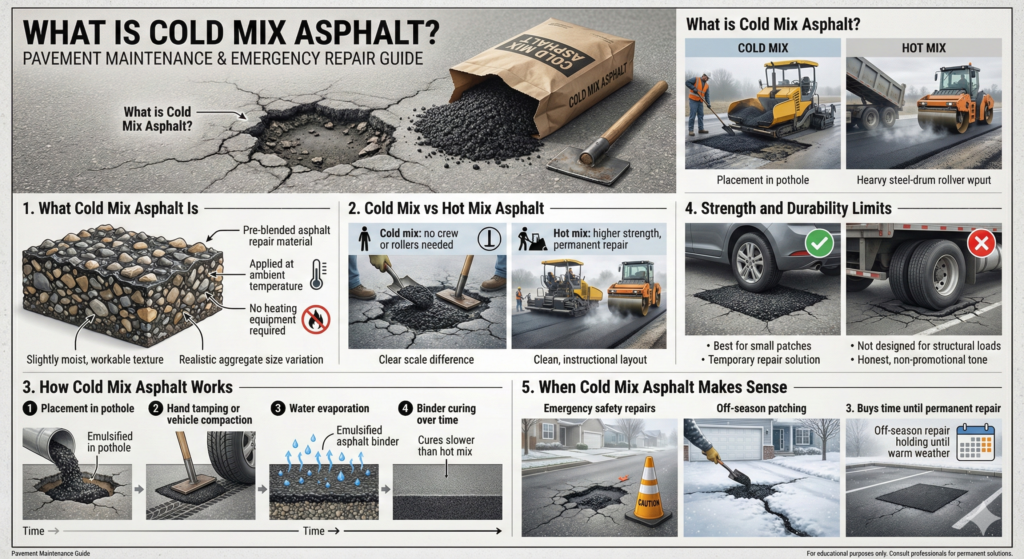
Cold mix asphalt is a pre-blended paving material that can be applied at ambient temperature without the need for heating equipment. It combines aggregate with a specially formulated asphalt emulsion or cutback binder that remains workable in cool conditions. According to research published by the National Institutes of Health (PMC), cold mix patching materials have gained increasing attention as a practical solution for emergency pavement maintenance.
Unlike HMA, cold mix doesn’t require a paving crew, heavy rollers, or a specific ambient temperature window. You can purchase it in bags from most hardware stores or have it delivered in bulk. That convenience makes it a popular choice for quick fixes, but it comes with trade-offs in durability and load-bearing capacity.
How Cold Mix Asphalt Works
Cold mix uses an emulsified asphalt binder, which is essentially liquid asphalt suspended in water. When the mix is placed and compacted (often by hand tamping or driving over it), the water evaporates and the asphalt binder gradually cures and hardens. This curing process takes longer than the rapid cooling of hot mix, which means the surface remains softer and more vulnerable to displacement during the first few days.
The Asphalt Institute notes in their maintenance guidelines (MS-16, Asphalt in Pavement Preservation and Maintenance) that cold mix materials are best suited for filling potholes and patching small areas where structural strength is not the primary concern. The material fills the void, prevents further water damage, and buys time until a permanent repair is possible.
When Cold Mix Asphalt Makes Sense
Cold mix is the right choice in a handful of specific situations. If you have a pothole that’s creating a safety hazard and you need it filled today, cold mix can handle that. If a section of your driveway develops a crack or small depression during the off-season, a cold patch can hold things together until warmer weather allows for a proper hot mix repair.
It’s also useful in emergency situations where common asphalt repair techniques need to be deployed quickly to prevent liability or further pavement failure. Cold mix fills that gap between identifying a problem and scheduling a full repair.
What Are the Key Differences Between Hot Mix and Cold Mix Asphalt?
The differences between hot mix and cold mix asphalt go beyond temperature. Each material is engineered for a different purpose, and understanding those distinctions helps you invest wisely. Data from Falcon RME shows that 60% to 80% of total patching cost goes toward materials and labor, so picking the right product from the start prevents wasted spending.
| Feature | Hot Mix Asphalt (HMA) | Cold Mix Asphalt |
| Production Temp | 300–350°F | Ambient (50–100°F) |
| Lifespan | 15–30 years | Weeks to months (up to 5 years max) |
| Best Use | Driveways, roads, parking lots | Pothole patches, temporary repairs |
| Installation | Professional crew and equipment | DIY-friendly or small crew |
| Load Capacity | High (supports heavy traffic) | Low (light traffic only) |
| Weather Needs | Ambient temp 40°F+ required | Works in any weather |
| Cost per Sq Ft | Higher upfront, lower long-term | Lower upfront, higher long-term |
| Recyclability | 95% reused in new pavements (NAPA) | Limited recyclability |
The FHWA’s pavement sustainability division highlights that asphalt is the most recycled material in the country, with an estimated 94.6 million tons of reclaimed asphalt pavement (RAP) reused in new mixes in 2021 alone. That environmental advantage applies almost exclusively to hot mix production.
How Long Does Each Asphalt Type Last?
Lifespan is one of the most important factors when comparing hot mix and cold mix asphalt. The gap between the two materials is significant, and it directly impacts your long-term cost.
Hot Mix Asphalt Lifespan
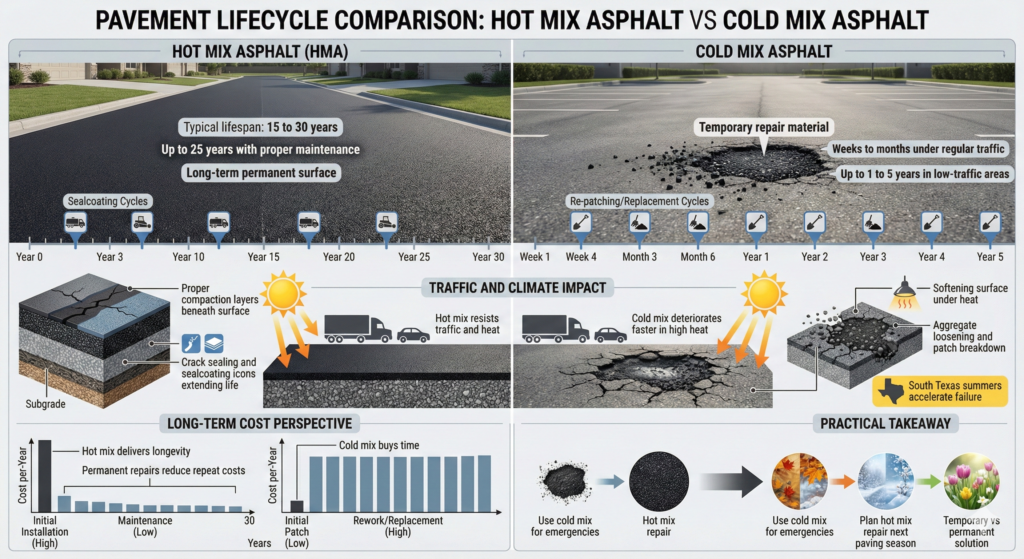
According to Walt’s Paving, a properly installed hot mix asphalt surface can last 15 to 30 years depending on traffic volume, climate conditions, and maintenance schedule. LeeBoy, a leading paving equipment manufacturer, cites up to 25 years as a realistic expectation for well-maintained HMA surfaces.
David E. Newcomb, Ph.D., P.E., former Vice President of Research and Technology at NAPA, has noted that asphalt pavement longevity is closely tied to proper mix design, adequate compaction, and a proactive maintenance strategy. Regular sealcoating and crack sealing can push a hot mix surface toward the upper end of that 15-to-30-year range.
Cold Mix Asphalt Lifespan
Cold mix asphalt is not designed for permanence. Under regular traffic, most cold mix patches begin to deteriorate within a few weeks to a few months. In low-traffic areas or sheltered locations, a premium cold mix product might hold up for one to five years. But in high-traffic zones, especially during South Texas summers, the material softens and breaks apart much faster.
The bottom line: cold mix buys you time, not longevity. If you’re patching a pothole today with cold mix, plan to follow up with a permanent hot mix repair within the next season.
Which Asphalt Mix Is Right for Your Project in South Texas?
South Texas offers some of the best conditions in the country for hot mix asphalt installation. The region’s warm temperatures extend the paving season well beyond what’s possible in northern climates, and the consistent heat helps HMA cure quickly and bond firmly. Here’s how to decide which material fits your situation.
Residential Driveways and Private Roads
For any driveway, private road, or residential access lane that you expect to use for years, hot mix asphalt is the clear winner. It provides a smooth, attractive surface that withstands daily vehicle traffic, resists water infiltration, and holds up against the intense UV exposure common in the Hill Country. With regular seasonal maintenance, a hot mix driveway can serve your property for two decades or more.
Cold mix is only appropriate here as a very short-term patch. If your driveway has a pothole or depression that needs attention before a paving crew can come out, a bag of cold mix from the hardware store can prevent further damage. But it’s not a substitute for professional paving.
Commercial Parking Lots and High-Traffic Areas
Commercial properties need surfaces that can handle heavy loads, constant turning movements, and the weight of delivery trucks. Hot mix asphalt is the industry standard for these applications. The asphalt manufacturing industry generates approximately $36.7 billion in annual revenue (IBISWorld, 2025), driven largely by commercial and municipal paving demand.
One commercial property owner in South Texas worked with C. Brooks Paving to resurface a 50,000-square-foot shopping center parking lot. The complete hot mix resurfacing reduced the property’s annual maintenance costs by 40% and extended the surface life by more than 15 years. That kind of return is only possible with a permanent, professionally installed HMA surface.
Emergency Repairs and Seasonal Patching
When a pothole appears in your parking lot on a Friday afternoon and you need it patched before Monday, cold mix is the right tool. It’s available without scheduling a crew, it can be applied in any weather, and it creates a safe, level surface almost immediately. For more on this type of repair, see our guide to pothole and asphalt patch repair.
Timothy Aschenbrener, Pavement Engineer with the FHWA Office of Preconstruction, Construction and Pavements, has noted that cold patching materials serve an important role in maintaining safe road conditions between scheduled maintenance cycles. The key is treating cold mix as a bridge to a permanent solution, not the solution itself.
Ready to Choose the Right Asphalt for Your Property?
Hot mix asphalt and cold mix asphalt each serve a distinct purpose. For driveways, parking lots, roads, and any surface that needs to perform for years, hot mix is the durable, cost-effective choice that property owners across South Texas rely on. Cold mix fills an important gap for emergency patches and temporary repairs, but it’s not built to last.
If you’re planning a paving project in Bulverde, the Hill Country, or anywhere in the greater South Texas area, C. Brooks Paving can help you choose the right material and install it correctly the first time. Contact C. Brooks Paving for a free consultation and get a professional assessment of your property’s paving needs.