Skip to content




The biggest red flags when hiring a paving contractor include unsolicited “leftover asphalt” offers, demands for full payment upfront (especially cash-only), no written contract, missing insurance documentation, and high-pressure sales tactics.
According to theFTC’s 2024 Consumer Sentinel report, Americans lost $12.5 billion to fraud that year, a 25% jump from 2023. Paving scams are a growing slice of that figure, with theBetter Business Bureau reporting individual losses topping $8,000.
Here’s what you need to know before you sign anything or hand over a deposit.
Key Takeaways
- Unsolicited “leftover asphalt” offers, cash-only demands, and missing credentials are the top red flags when hiring a paving contractor.
- Fraud losses reached $12.5 billion nationally in 2024, and home improvement contractors rank among the most complained-about industries with the BBB.
- Protect yourself by requiring written contracts, verifying insurance directly, comparing 3+ bids, and hiring local with a proven track record.
Why Paving Scams Are More Common Than You Think
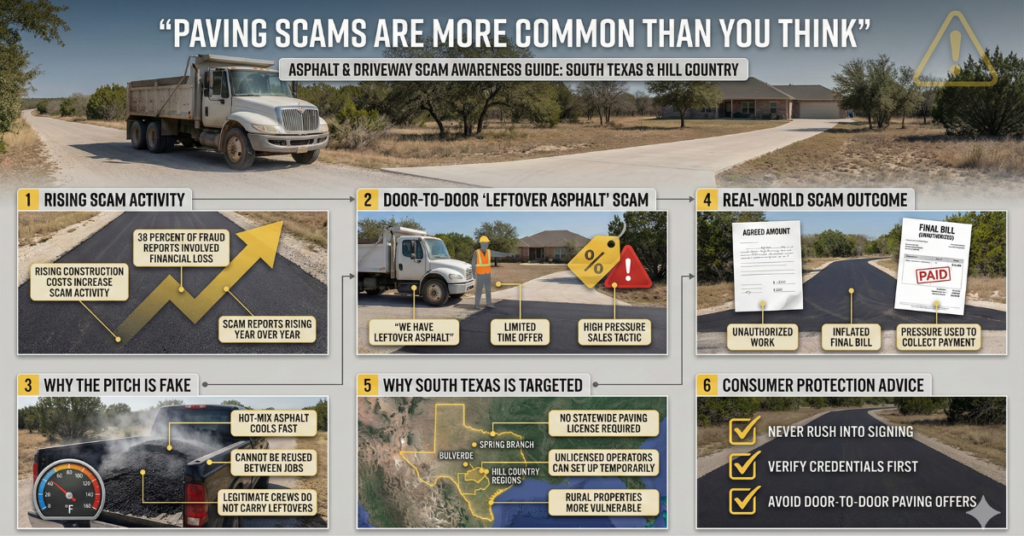
Paving scams have increased across the U.S., driven by rising construction costs and homeowners looking for affordable driveway repairs. The BBB’s Scam Tracker has logged numerous reports of contractors tricking homeowners with seemingly good deals, only to deliver shoddy work or disappear entirely. Data from the FTC’s 2024 fraud report shows that 38% of people who reported fraud lost money, up from 27% in 2023.
Door-to-Door “Leftover Asphalt” Pitch
This is the most common asphalt paving scam in the country. A crew pulls up uninvited and claims they just finished a job nearby with leftover material. They offer to pave or resurface your driveway at a steep discount.
Robyn Householder, President and CEO of BBB Middle Tennessee and Southern Kentucky, warned in a 2025 scam advisory that these scammers deliberately target homeowners who feel pressured at their door, using urgency to collect payments before victims react. In one case, a couple agreed to a $1,500 patch job and was billed $64,000 after the crew paved the entire driveway without authorization.
Legitimate contractors don’t carry “leftover” hot-mix asphalt between sites. The material cools quickly and must be laid within a narrow temperature window to bond properly.
Why South Texas Properties Are Targeted
Texas does not require a statewide general contractor license, per Procore’s licensing guide. While trades like electrical and plumbing need state credentials, paving contractors can operate without standardized licensing, making it easier for unlicensed operators to set up temporarily.
The Texas Attorney General advises homeowners to never let anyone rush them into signing and to verify a contractor’s credentials first. Rural properties in Bulverde, Spring Branch, and the Hill Country are especially vulnerable due to larger lots and greater distance between neighbors.
What Are the Biggest Red Flags When Hiring a Paving Contractor?
Knowing the warning signs before you get a quote can save you thousands of dollars. These red flags apply whether you’re evaluating a residential driveway or a commercial parking lot.
No Written Contract or Detailed Estimate
A trustworthy paving contractor always provides a written estimate before work begins. If a contractor offers only a verbal agreement or resists putting details in writing, walk away.
The Texas Attorney General’s office warns specifically about signing contracts with blanks in them. Scam operators sometimes collect a signature on an incomplete form, then fill in inflated prices afterward. A proper estimate should include line-item costs, material specs, project timeline, warranty terms, and payment schedule.
Demands for Full Payment Upfront (Especially Cash-Only)
A demand for the full project cost before work starts is one of the clearest paving contractor warning signs, especially when the contractor insists on cash only.
According to the BBB’s asphalt scam advisory, many victims report paying a large deposit only to have the contractor vanish. Contact numbers stop working and emails go unanswered. Legitimate paving companies structure payments in stages: a small deposit (often 10-30%), progress payments, and a final balance upon satisfactory completion.
Missing Licensing, Insurance, or Bond Information
Every paving contractor should carry general liability insurance and workers’ compensation coverage. Without proof of insurance, you could be held liable for injuries or property damage during the project.
The BBB recommends calling the insurance carrier directly to confirm coverage for worker’s compensation, property damage, and personal liability. While Texas doesn’t mandate a statewide paving license, many cities in the Bulverde and San Antonio area require local permits. Always ask what permits your project needs.
High-Pressure Sales Tactics and “Today Only” Deals
Reputable contractors won’t pressure you into signing on the spot or claim pricing is only valid for the next hour. FEMA’s post-disaster fraud advisory identifies high-pressure tactics as one of the most reliable indicators of a scam operation. If a contractor won’t leave a written estimate for you to review overnight, treat that as a serious warning sign.
No References, Portfolio, or Online Presence
A paving company that’s served its community should have verifiable references and an online presence. Terry Smith, COO at Rose Paving with decades of experience, advises property owners to choose a contractor who brings experience, transparency, and a proven track record. If a company has no digital footprint, they may be operating under different names to avoid negative reviews.
How Can You Tell if a Paving Company Is Legitimate?
Legitimate paving companies share several traits that set them apart from fly-by-night operators.
Check for Verifiable Business Credentials
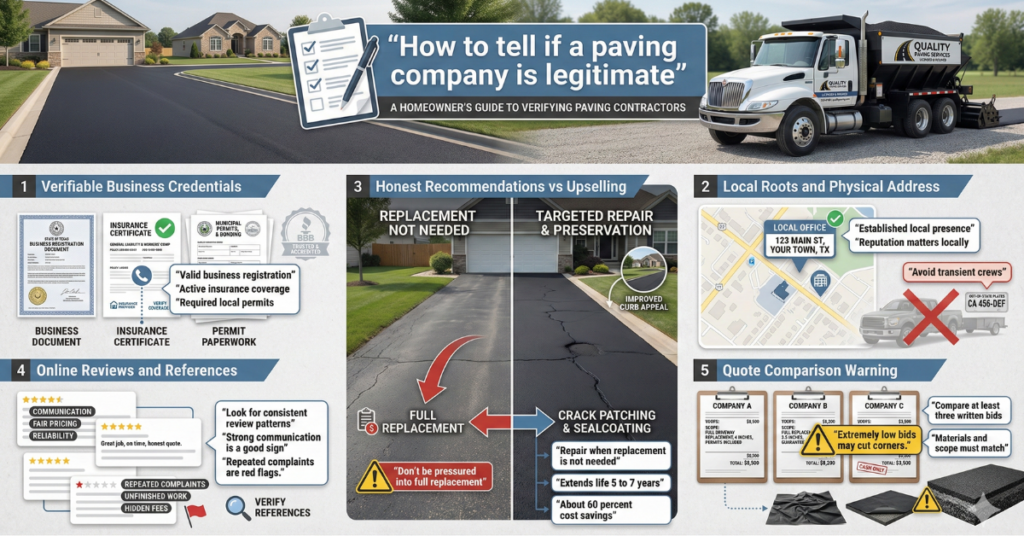
Confirm the company has valid business registration, appropriate insurance, and required local permits. Check the BBB for ratings, complaint history, and accreditation status. Ask for a certificate of insurance and call the provider directly to verify it’s current.
Look for Local Roots and a Physical Address
Scam contractors often operate out of pickup trucks with out-of-state plates. A company with local roots has far more at stake when it comes to reputation.
One homeowner we worked with faced a choice between full driveway replacement and targeted repair on a 20-year-old cracked driveway. After evaluation, we recommended strategic patching followed by sealcoating: extended life of 5 to 7 years at 60% cost savings with improved curb appeal. That honest recommendation is what separates a trusted local paving contractor from a transient crew chasing a quick payday.
Read Online Reviews and Ask for References
Look for patterns in reviews: consistent praise for communication and fair pricing is a positive sign, while repeated complaints about surprise charges or unreturned calls are red flags. The BBB recommends gathering three written quotes and comparing them side by side. A bid dramatically lower than others may mean the contractor is cutting corners on materials.
What Should a Trustworthy Paving Estimate Include?
A detailed estimate is one of the strongest signs you’re dealing with a professional. Vague or incomplete estimates are a red flag.
Line-Item Breakdown of Materials, Labor, and Prep
Your estimate should separate costs for materials, labor, site preparation, and additional services. According to HomeGuide’s 2025 cost data, the average asphalt driveway project costs between $3,130 and $7,403, with pricing ranging from $5 to $12+ per square foot. If a quote falls far outside this range, ask why.
Asphalt Thickness, Base Specs, and Timeline
The estimate should specify asphalt thickness (typically 2 to 3 inches for residential), base material type and depth, and project timeline. A contractor who skips base preparation may offer a lower price, but the surface will deteriorate much faster. Understanding the full asphalt paving process for Texas properties helps you evaluate whether an estimate reflects professional-grade work.
Warranty Terms and Payment Schedule
Reputable contractors offer warranties on materials and workmanship. Your estimate should clearly state warranty duration, coverage, and what voids it. The payment schedule should tie to project milestones, not demand full payment before work is complete.
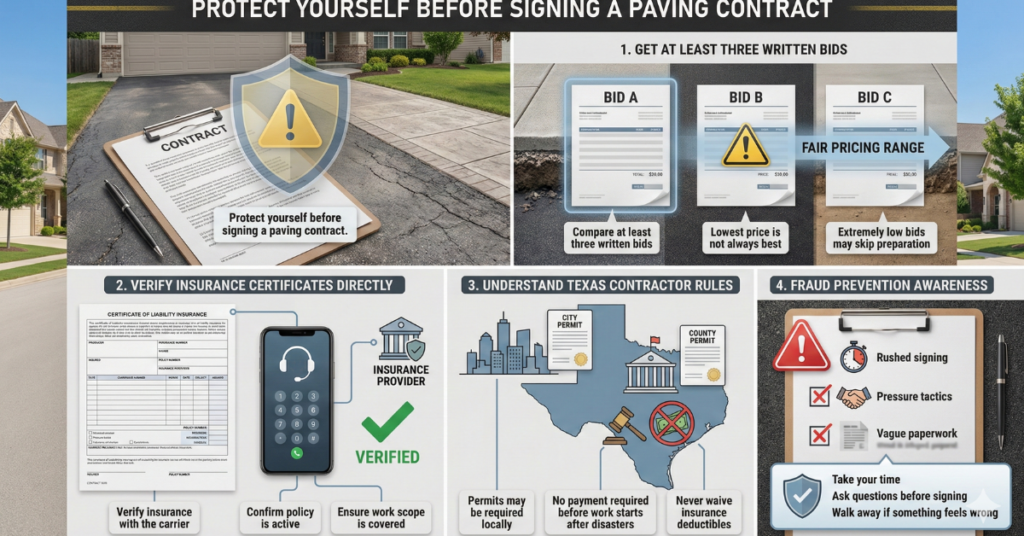
How to Protect Yourself Before Signing a Paving Contract
A few simple steps before you commit can dramatically reduce your risk.
Get at Least Three Written Bids
Multiple bids establish a baseline for fair pricing. The BBB’s hiring guide emphasizes the lowest bid isn’t necessarily the best. A dramatically lower offer may signal substandard materials or skipped preparation.
Verify Insurance Certificates Directly
Don’t accept a printed certificate at face value. Call the carrier to confirm the policy is active and covers the work being performed. This takes minutes and prevents major financial exposure.
Understand Texas Contractor Requirements
Your city or county may require permits even though Texas lacks a statewide general contractor license. The Texas Department of Insurance reminds homeowners that it’s illegal for out-of-town contractors working after a disaster to require payment before starting, and it’s against the law to waive your insurance deductible.
For additional protective measures, our complete guide to avoiding asphalt paving scams covers what to do if you suspect fraud.
Ready to Work With a Paving Contractor You Can Trust?
Hiring a paving contractor doesn’t have to be stressful. Require written contracts. Verify insurance directly. Get at least three bids. And trust your instincts: if an offer feels too good to be true, it almost certainly is.
At C. Brooks Paving, we’ve built our reputation in Bulverde and the South Texas Hill Country by doing the opposite of everything on this red flags list. We provide detailed written estimates, carry full insurance, and always recommend the most cost-effective solution for your property.
Have questions about an upcoming driveway pavingproject? Contact C. Brooks Paving for a free consultation. We’re here to help you make the best decision for your property.