 Skip to content
Subdivision Paving for HOAs & Developers Across the Texas Hill Country
Expert asphalt maintenance, repair & new development paving for Texas subdivisions. C. Brooks Paving delivers quality HOA roadwork built for Hill Country weather.













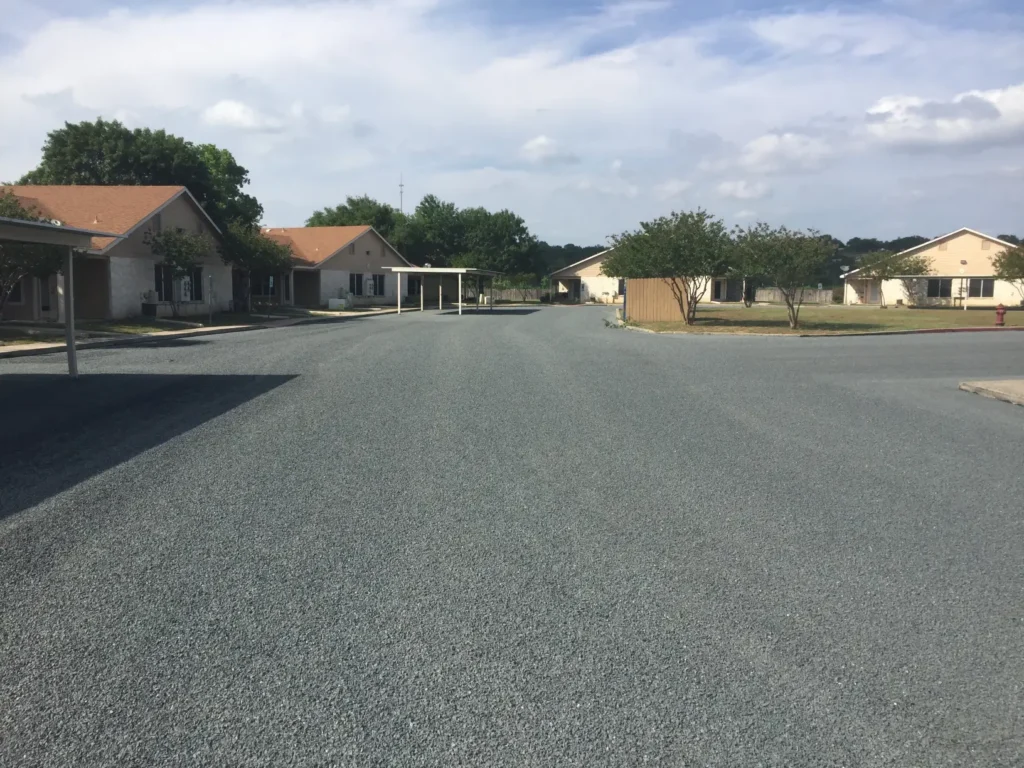
Professional Subdivision Paving Services for HOAs & Developers in the Texas Hill Country
Subdivision roads and HOA-maintained streets occupy an unusual position in the Texas paving landscape, they’re private infrastructure carrying public-equivalent traffic loads, and the responsibility for maintaining them falls entirely on the HOA board or developer rather than a municipality with a dedicated public works budget. When those roads deteriorate, the board faces a choice between reactive repair funded from reserve accounts and proactive maintenance structured around the HOA’s annual budget cycle. The difference between those two paths is significant: Asphalt Pavement Alliance research indicates that roads maintained with timely crack sealing and sealcoating cost 4-5 times less per lane-mile over a 20-year period than roads that defer maintenance until resurfacing or reconstruction becomes unavoidable.
New subdivision developments in Central Texas and South Texas face a different but related challenge, installing road infrastructure that will perform across decades under the region’s specific conditions. Hill Country and Central Texas limestone sub-grades expand and contract seasonally with moisture, creating sub-surface voids that cause pavement cracking and base failure years ahead of design life if the installation doesn’t account for it. The Federal Highway Administration’s pavement design standards identify sub-grade preparation and base compaction as the two factors most responsible for long-term pavement performance, standards that apply equally to a new subdivision’s internal road network as to a state highway.
Brooks Paving works with HOA boards, property management companies, and residential developers throughout the Texas Hill Country, Central Texas, and South Texas. From new subdivision road construction through ongoing HOA maintenance programs, chip seal applications on budget-conscious community roads, crack repair, and full resurfacing, we deliver the complete scope. Every estimate is written, every scope is phased to work within your budget cycle, and the owner is on every job.
Comprehensive Subdivision Paving Solutions
Our full-service paving solutions support everything from HOA chip seal paving to long-term planning for subdivision resurfacing or crack control. We build, maintain, and protect community roadways with care and precision.
NEW DEVELOPMENT PAVING SOLUTIONS
New Development Paving Solutions for Texas Subdivisions
Installing a subdivision road network correctly from the start is the most cost-effective investment a developer can make in the long-term value and reputation of their project. Buyers notice road quality on their first drive-through, and HOA boards inherit whatever the developer built. New development paving in Central and South Texas requires a site-specific approach: sub-grade assessment and stabilization before any base is placed, base depth sized for the internal road classification and expected traffic, drainage design that routes runoff away from road edges and building pads, and hot-mix asphalt specified for the regional temperature profile using performance-graded binder appropriate for Texas summer heat extremes. The Asphalt Institute's SuperPave specification system establishes the binder grade selection process for regional temperature conditions, we apply those specifications on every new development project so roads perform as designed through Central Texas heat cycles rather than softening and deforming under summer vehicle loads.
We install new subdivision roads, commercial complex internal drives, entrance roads, and community amenity access paths. We also install line striping, stop bar markings, and speed bump transitions as part of new development completions, one contractor from sub-grade through final striping. See our line striping services for what we include in development project completions.
HOA ASPHALT MAINTENANCE & REPAIR SERVICES
HOA Asphalt Maintenance & Repair: Crack Sealing, Chip Seal, and Resurfacing
HOA boards managing asphalt road networks in Bulverde, Boerne, Dripping Springs, and across Central and South Texas face the same core question every few years: repair, resurface, or replace? The answer depends on what's actually happening beneath the surface, and a contractor who defaults to the most expensive recommendation isn't working in the community's interest.
We assess HOA road networks by condition zone: sections with surface cracking and intact base are candidates for crack sealing followed by sealcoating or chip seal; sections with widespread surface deterioration and sound base structure receive hot-mix overlay; sections with base failure require full-depth repair or reconstruction before any surface treatment. This tiered assessment approach, recommended by the Asphalt Pavement Alliance's pavement preservation framework, lets HOA boards allocate maintenance funds where they generate the most pavement life per dollar spent.
Chip seal is a particularly cost-effective option for lower-volume HOA community roads. At roughly 30-50% of the cost of hot-mix asphalt overlay, chip seal extends road life by 5-7 years when applied to a structurally sound surface, making it the right answer for community roads that don't need a full resurface but need more than just crack sealing. We apply chip seal across Hill Country and Central Texas subdivisions and can structure a multi-year maintenance agreement that rotates crack sealing, chip seal, and periodic resurfacing across your community's road network on a budget-cycle-friendly schedule.
See our asphalt crack repair, sealcoating, and chip seal paving pages for individual service details.
Why Choose C. Brooks Paving for Your Subdivision Projects

A+ BBB Accredited
Accredited with the Better Business Bureau and maintaining an A+ rating since our founding.
Owner on Every Job Site
Courtnay Brooks is present at every project. You’re not handing your property over to a subcontractor.
All Work Guaranteed in Writing
Every estimate and every job is documented. No verbal promises. No hidden charges.
State-of-the-Art Equipment
We run Etnyre, Bear Cat, and Leeboy equipment, some of the best chip seal and asphalt machinery available in the region.

Our Process for Subdivision Projects
Free Estimate & Site Visit
We’ll come out, look at the project, and give you a clear price.
Proposal
We will gather all the information and provide you with a detailed scope of the project that fits within your budget and timeline
Construction
The work is scheduled and construction begins while you are kept in the loop every step of the way
Free Estimate & Site Visit
We’ll come out, look at the project, and give you a clear price.
Proposal
We will gather all the information and provide you with a detailed scope of the project that fits within your budget and timeline
Construction
The work is scheduled and construction begins while you are kept in the loop every step of the way
Frequently Asked Questions About Subdivision Paving
At what stage of development should paving be scheduled?
For new subdivisions, base course paving should be scheduled after underground utilities, water, sewer, gas, electrical conduit, are installed and backfilled, and after any utility inspection requirements are completed. Paving over utility trenches before the backfill has adequately settled creates surface depressions that are expensive to correct later. Final surface paving is typically the last construction phase before community turnover. We coordinate with your development timeline during the estimate process and flag utility coordination requirements in the written proposal.
Can you match the existing pavement's appearance for maintenance projects?
For crack repair and patching, new asphalt is noticeably darker than oxidized existing pavement, that contrast fades over 6-12 months of UV exposure. For overlay and resurfacing, the full road surface is replaced so color uniformity is restored across the section. For chip seal applications, aggregate selection can be coordinated to complement existing community aesthetics. When appearance consistency is a priority for an HOA community, sealcoating the entire road after crack repair is the most effective way to restore uniform color and surface appearance in a single pass.
How do you minimize disruption to residents during repair projects?
We phase HOA and subdivision repair work to keep road access available throughout the project. Before work begins, we coordinate with the HOA board or property manager on a schedule that allows us to notify residents with adequate lead time, typically 48-72 hours minimum before any lane closure or road access restriction. Most HOA road sections can be paved, cured, and reopened within 24-48 hours depending on scope. For chip seal applications, the surface requires a curing period before normal vehicle traffic resumes, we specify that timeline in the proposal so residents know what to expect.
What is the difference between chip seal and asphalt overlay for HOA roads?
Chip seal is a surface treatment, liquid asphalt binder applied to the existing road, followed by aggregate (chip) spread and rolled into the surface. It costs roughly 30-50% less than hot-mix asphalt overlay and extends road life by 5-7 years when applied to a structurally sound surface. It works best on lower-volume community roads without heavy stop-start traffic patterns. Hot-mix asphalt overlay is a structural surface layer that restores road grade and drainage and performs well under higher traffic volumes and at stop signs and intersections where chip seal can ravel under repeated braking loads. We assess your road’s condition and traffic pattern and recommend the right option for each section, not one product across the entire network. See our chip seal paving page for detailed service information.
How often should HOA roads be maintained?
A well-structured HOA road maintenance program includes crack sealing annually or as needed when surface cracks appear, sealcoating every 2-3 years, chip seal or overlay when the surface has deteriorated beyond what sealcoating can address, and reconstruction only when the base has failed. On this schedule, a properly built HOA road network should serve the community for 20-25 years before major capital rehabilitation is required. The biggest driver of shortened road life is deferred maintenance, roads that go 8-10 years without any treatment typically require resurfacing at 4-5 times the cost of what preventive maintenance would have spent over the same period.
Do you serve commercial complex and mixed-use development road networks?
Yes. Commercial complex internal drives, shared parking lot access roads, and mixed-use development road networks are part of our subdivision and development paving scope. These surfaces often carry a mix of passenger vehicle and delivery truck traffic that requires heavier base depth and a higher-stability asphalt mix than a purely residential community road. We scope commercial complex paving separately from residential subdivision work and spec each road section based on its actual load profile and traffic classification. See our commercial paving page for more on commercial road and parking lot services.
Where do you provide subdivision and HOA paving services in Texas?
We serve HOA communities, residential developers, and commercial property managers across 25 communities throughout the Texas Hill Country, Central Texas, and South Texas, from Boerne, Kerrville, Wimberley, and Dripping Springs in the Hill Country to San Marcos, Seguin, and Pleasanton in Central and South Texas. Our Bulverde base puts us within reach of most Hill Country and Central Texas subdivisions with no fuel surcharge within our standard service area. See the full list on our service areas page.
our services
- We proudly serve: