Skip to content





HOA road paving is a commercial-scale project that demands careful budgeting, a qualified contractor with community experience, and a clear plan to minimize resident disruption. Board members who treat it like a simple driveway job risk overspending, premature pavement failure, and frustrated homeowners. Here is what your board needs to know before signing a contract.
Community roads represent one of the largest capital expenses a homeowner association will ever manage. According to the Federal Highway Administration (FHWA), well-maintained asphalt pavements are expected to last at least 20 years, but only when the right contractor installs them and a proactive maintenance strategy follows.
Key Takeaways
- HOA road paving is commercial work. Community roads handle heavy traffic, require proper drainage, and must meet accessibility standards that residential driveway contractors typically cannot address.
- Budget with a reserve study first. Commercial asphalt paving costs $3 to $8 per square foot in 2025, and a proper reserve fund prevents surprise special assessments.
- Hire for experience, not just price. A qualified HOA paving contractor should offer a site evaluation, transparent scope of work, licensing proof, and a phased scheduling plan.
- Preventive maintenance saves money long-term. Sealcoating and crack sealing can extend pavement life by 10 to 15 years and cost roughly three times less than corrective repairs.
Why HOA Road Paving Is a Commercial-Grade Project
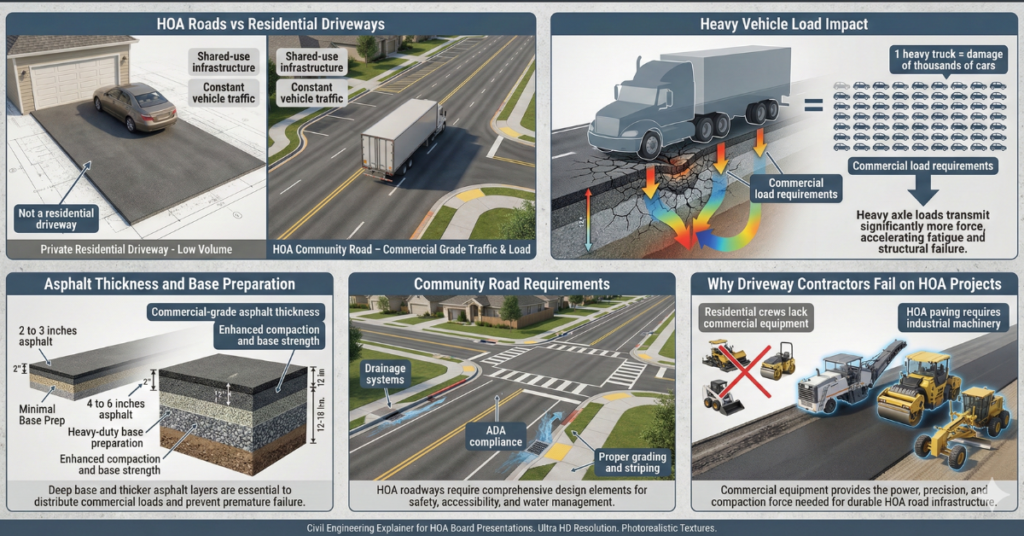
Many board members assume community road paving is similar to repaving a residential driveway. It is not. HOA road paving involves shared-use infrastructure, including access lanes, parking areas, fire lanes, and loading zones, that sees constant traffic from residents, delivery trucks, and service vehicles.
According to the U.S. General Accounting Office (GAO), a single 18-wheeler inflicts road damage equivalent to roughly 9,600 passenger vehicles. That load requires commercial-grade base preparation and asphalt thickness of 4 to 6 inches rather than the 2 to 3 inches used on residential driveways.
What Makes Community Roads Different From Residential Driveways
Private community roads are often not built to local Department of Transportation standards, particularly where rapid growth pushed builders to cut costs during original construction. Community roads must also accommodate drainage systems, ADA-compliant walkways, properly graded intersections, and clear striping. C. Brooks Paving offers subdivision paving services and commercial paving solutions designed for HOA and developer projects across the South Texas Hill Country.
As paving industry experts at The Pavement Group warn, if your HOA is getting quotes from driveway contractors, the project is already set up to fail. Residential crews may lack the heavy-duty machinery needed for large-scale milling, grading, and compaction.
How Should an HOA Board Budget for Road Paving?
Budgeting for an HOA road paving project starts well before the first contractor is contacted. A clear financial picture protects the board from unexpected costs and helps avoid the need for special assessments that frustrate homeowners. The foundation of smart budgeting is a professional reserve study, combined with a realistic understanding of current paving costs.
Why Reserve Studies Matter for Paving Projects
A reserve study evaluates the current condition of your community’s major assets and projects the cost and timing of future repairs or replacements. The Community Associations Institute (CAI) recommends that all HOAs maintain reserve funds earmarked for long-term capital expenses like road paving, and 13 U.S. states now require regular reserve studies by law.
Thomas M. Skiba, CAE, chief executive officer of the Community Associations Institute, emphasizes this point: “One of the primary responsibilities of a community association board is to protect, maintain, and enhance the assets of the association.” Skiba adds that a proactive preventive maintenance plan and periodic inspections should be built into every community’s long-term planning to properly evaluate and budget for ongoing care.
What Does HOA Road Paving Typically Cost?
According to The Pavement Group’s 2025 cost analysis, commercial asphalt paving typically costs between $3 and $8 per square foot. That range depends on project size, base condition, traffic load, and regional labor rates. To help your board compare options, here is a quick breakdown:
| Paving Treatment | Estimated Cost per Sq Ft | Typical Use Case |
| Full-depth asphalt paving | $3.00 to $8.00 | New roads, full replacement |
| Asphalt resurfacing (overlay) | $1.50 to $3.00 | Sound base, worn surface |
| Sealcoating | $0.15 to $0.30 | Preventive maintenance every 2-3 years |
One shopping center owner C. Brooks Paving worked with faced similar decisions across a 50,000-square-foot parking lot. By investing in a complete resurfacing with improved drainage, they reduced annual maintenance costs by 40% and extended the surface life by over 15 years. HOA boards can apply the same long-term approach to community road projects.
What to Look for When Hiring an HOA Paving Contractor
Selecting the right contractor is the single most important decision your board will make during a community paving project. A strong contractor does more than lay asphalt. They evaluate your site, develop a detailed scope of work, communicate with the board, and phase the project to minimize resident inconvenience.
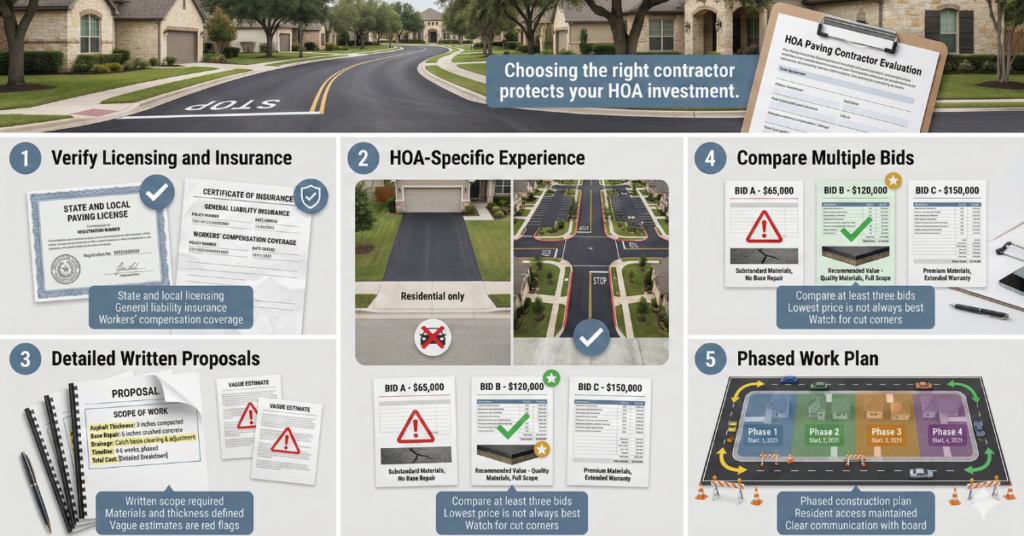
How to Evaluate an HOA Paving Contractor in 5 Steps
- Verify licensing and insurance. Confirm that every bidder holds proper state and local licenses, carries general liability insurance, and provides workers’ compensation coverage.
- Check HOA-specific experience. Ask for references from other associations or property management companies. Skip contractors whose portfolio is limited to residential driveways.
- Request detailed written proposals. Each bid should outline scope, materials, asphalt thickness, base repair, drainage work, timeline, and total cost. Vague verbal estimates are red flags.
- Compare at least three bids side by side. The lowest number is not always the best value. A significantly cheaper bid may cut corners on base depth, compaction, or material quality.
- Confirm a phased work plan. Your contractor should explain how they will keep portions of the road network open so residents maintain access throughout the project.
For a detailed guide on evaluating paving contractors, visit C. Brooks Paving’s resource on how to choose an asphalt paving contractor near you.
Does Your HOA Need to Meet ADA Compliance for Paving?
Accessibility is a critical consideration in any community road paving project, and overlooking it can expose the association to legal liability. While the Americans with Disabilities Act does not automatically apply to every HOA, the Federal Fair Housing Act requires all associations to make reasonable accommodations for residents with disabilities.
According to community association legal experts, the ADA applies to HOAs that operate facilities as public accommodations. If your clubhouse, pool, or parking areas host public events or accept outside memberships, those spaces must meet ADA accessibility standards, including properly graded walkways, accessible parking spaces with correct signage, and ramps where needed.
Build accessibility into the paving scope from the start. This includes accessible parking spaces, curb ramps at pedestrian crossings, smooth surface transitions, and clear wayfinding striping. C. Brooks Paving helps communities meet these standards through ADA-compliant line striping and parking lot layouts designed for Texas properties.
How Does Preventive Maintenance Protect Your HOA’s Paving Investment?
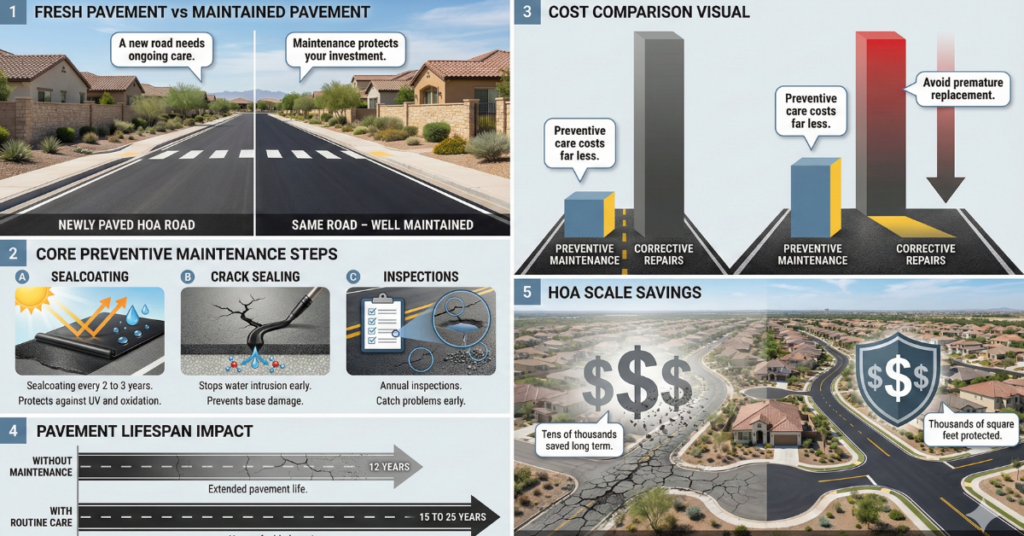
A freshly paved road is only as good as the maintenance plan that follows. Without routine care, even the highest-quality community paving project will deteriorate faster than expected. Preventive maintenance is the most cost-effective way to protect your community’s investment and avoid premature full replacement.
Sealcoating, Crack Sealing, and Inspections
A complete maintenance plan should include three core components. Sealcoating applies a protective layer to the asphalt surface every 2 to 3 years, shielding it from UV damage and oxidation. Crack sealing addresses small fissures before water penetrates the base layer. Regular inspections, conducted at least annually, catch early warning signs like minor cracking and drainage problems before they escalate.
For detailed guidance on scheduling these treatments, read C. Brooks Paving’s guide on sealcoating timing and frequency.
The Financial Case for Preventive Care
According to industry maintenance data from OneCrew, preventive treatments cost roughly three times less than corrective repairs. Asphalt surfaces can last 15 to 25 years depending on installation quality and how consistently maintenance is performed. For an HOA managing thousands of square feet of roads, the difference between a surface that lasts 12 years and one that lasts 22 years represents tens of thousands of dollars in avoided replacement costs.
Take the Next Step for Your Community’s Roads
HOA road paving is one of the most significant investments your board will manage. Start with a thorough reserve study, set realistic budget targets, and partner with a contractor who understands community projects. Build accessibility into the scope from day one, and commit to a preventive maintenance plan that protects your investment for decades.
Ready to plan your HOA road paving project? C. Brooks Paving brings multi-generational experience to subdivision and community paving across the South Texas Hill Country. Contact C. Brooks Paving for a free consultation and get expert guidance tailored to your community’s specific needs.