Skip to content





During a professional paving estimate visit, a contractor will inspect your property in person, evaluate your existing surface and subgrade, assess drainage and grading, take precise measurements, discuss material options, and provide a detailed written proposal.
The entire process typically takes 30 to 60 minutes and is one of the most important steps you can take before investing in a new driveway, parking lot, or paved surface. Here’s what you need to know so you feel confident and prepared.
Key Takeaways
- A professional paving estimate requires an in-person site visit. Phone-only quotes often miss critical details like drainage issues, subgrade condition, and accurate measurements, which can lead to surprise costs later.
- The visit covers five key areas: surface condition, subgrade stability, drainage patterns, measurements, and material recommendations tailored to your property.
- A properly maintained asphalt surface can last 15 to 30 years, according to industry data from Angi, but that lifespan depends heavily on the quality of the initial site evaluation and installation.
- You should receive a detailed, itemized written estimate that includes materials, labor, site preparation, timeline, and warranty information.
- Preparing your property and questions ahead of time helps your contractor deliver a more accurate, transparent proposal.
What Is a Paving Estimate Visit (And Why Does It Matter)?
A paving estimate visit is an in-person consultation where a professional contractor comes to your property, evaluates the conditions on the ground, and develops a detailed proposal for your paving project. It’s the foundation of every successful driveway, parking lot, or private road installation.
This step matters because asphalt paving typically costs between $7 and $15 per square foot, including materials and labor. For a standard two-car driveway, that can add up to $5,000 or more. With that kind of investment on the line, getting the details right from the start helps you avoid costly repairs down the road.
Why an On-Site Visit Beats a Phone Quote
A phone estimate might sound convenient, but it leaves too much to guesswork. As the team at EastCoat Pavement Services advises, you should be cautious if a paving company quotes you over the phone without actually visiting the site. A professional paving contractor needs to inspect the property in person to assess the current surface condition, take accurate measurements, identify hidden issues, and put together a realistic plan and price.
Without a site visit, it’s easy for a contractor to say, “We didn’t account for this,” after work has already started. An in-person inspection eliminates that risk and sets clear expectations for both sides.
What a Professional Estimator Looks For
When a qualified estimator arrives at your property, they’re evaluating several things at once. Their trained eye is scanning for surface damage, subgrade stability, water flow patterns, access points for equipment, and the overall scope of the project.
Terry Smith, Chief Operating Officer at Rose Paving and a seasoned expert with decades of hands-on experience in the paving industry, stresses that a proper pavement assessment should always be documented with photos, recorded dates, and noted severity levels. He explains that organized documentation supports better budgeting decisions and can be valuable if any questions arise later.
A thorough estimator doesn’t just look at the surface. They’re thinking about what’s underneath it, what’s around it, and how the finished product will perform over time in South Texas conditions.
How Should You Prepare for Your Paving Estimate?
A little preparation on your part goes a long way toward getting a more accurate and useful estimate. The more information you can provide, the better your contractor can tailor their recommendations to your specific property.
Clear the Area and Note Problem Spots
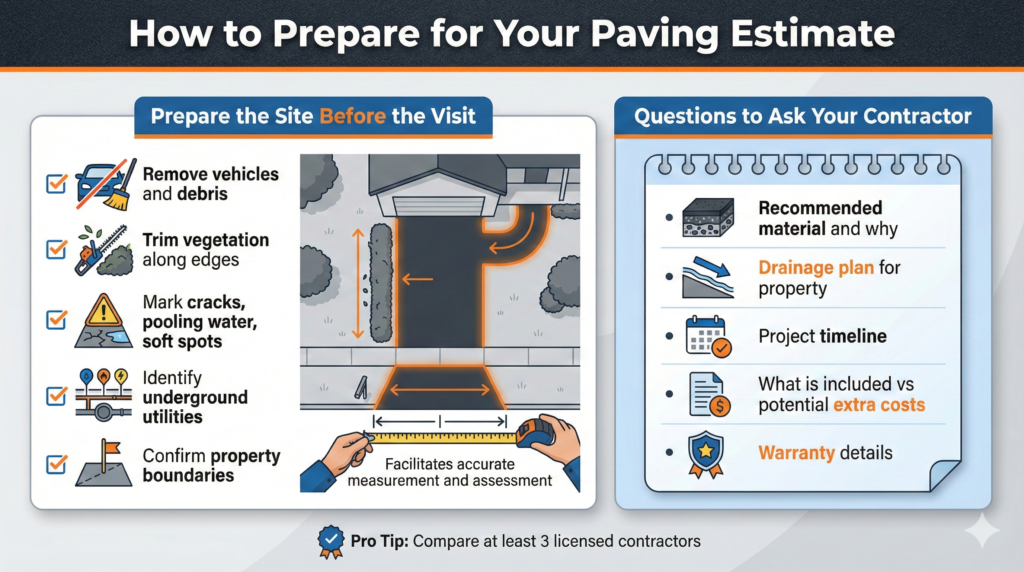
Before your contractor arrives, take a few minutes to prepare the site:
- Remove vehicles, equipment, and debris from the area that will be evaluated.
- Trim back any vegetation that’s growing over the edges of your current surface or blocking access.
- Mark or note problem spots you’ve noticed, such as cracks, pooling water, soft areas, or uneven sections.
- Identify underground utilities if you know their locations, including sprinkler lines, gas lines, or electrical conduits.
- Check your property boundaries so the contractor knows exactly how far the paved area can extend.
Taking these steps saves time during the visit and ensures nothing important gets overlooked.
Gather Key Questions Before Your Contractor Arrives
Walking into the estimate with a list of questions helps you get the most value from the visit. According to Angi’s contractor hiring guide, homeowners should request quotes from at least three licensed contractors and verify their insurance, check references, and ask to see completed projects similar to theirs.
Here are questions worth having ready:
- What material do you recommend for my property, and why?
- How will you handle drainage on my site?
- What does the timeline look like from start to finish?
- What’s included in the estimate, and what could trigger additional costs?
- Do you offer a warranty on materials and workmanship?
Writing these down before the visit keeps the conversation focused and productive.
What Happens During the Site Inspection?
The site inspection is the core of the paving estimate visit. This is where the contractor gathers the information needed to build an accurate, reliable proposal. A professional site inspection typically follows this process:
- Walk-through and discussion of your goals, concerns, and expectations for the project.
- Visual inspection of the existing surface for cracks, potholes, settling, and overall condition.
- Subgrade evaluation to check the stability and composition of the soil beneath the surface.
- Drainage and grading assessment to identify water flow patterns, low spots, and slope requirements.
- Precise measurements of the area to be paved, including length, width, and any irregular shapes.
- Material and thickness recommendations based on the intended use, traffic load, and local climate.
- Photo documentation and notes to support the written estimate.
Each of these steps plays a critical role in the accuracy of your final proposal.
Surface and Subgrade Assessment
The condition of what’s underneath your paved surface is just as important as the surface itself. Asphalt paving experts at FixAsphalt.com emphasize that a contractor who takes the time to evaluate subgrade condition and assess drainage needs is demonstrating a genuine commitment to quality and durability. They note that skipping this step has led to property owners spending over $500,000 on paving projects that began failing within months due to undetected subgrade problems.
Your contractor should check for:
- Soft or saturated soil that could shift under the weight of asphalt
- Clay-heavy soil that retains water and expands, which is common in parts of South Texas
- Previous patches or repairs that may indicate recurring structural issues
- Tree roots growing near or under the paving area that could cause future heaving
According to the Federal Highway Administration (FHWA), proper surface preparation, including subgrade evaluation and compaction, is one of the most critical factors in achieving long-lasting asphalt pavement performance. The FHWA’s Hot Mix Asphalt Paving Handbook, developed in partnership with the National Asphalt Pavement Association (NAPA), outlines quality standards that experienced contractors follow during site assessment and installation.
Drainage and Grading Evaluation
Water is the number one enemy of paved surfaces. Standing water seeps into cracks, weakens the base layer, and accelerates deterioration. That’s why evaluating drainage is a non-negotiable part of every paving estimate visit.
Your contractor should check for areas where water pools after rain, identify the natural slope of your property, and determine whether additional grading or drainage solutions are needed. Industry standards call for a minimum 2% slope on asphalt surfaces to ensure proper water flow away from structures and prevent pooling.
In South Texas, where heavy rain events can drop several inches in a short period, proper drainage planning is especially important. A contractor who understands local weather patterns and soil conditions will factor these into their recommendations for asphalt paving in South Texas.
Measurements and Material Recommendations
Accurate measurements are essential for calculating material quantities, labor hours, and overall project cost. Your estimator will measure the full dimensions of the area to be paved and note any curves, slopes, or transitions that require special attention.
Based on what they find during the inspection, the contractor will recommend the best material for your situation. For most residential driveways in our area, hot-mix asphalt is the standard choice. It’s durable, cost-effective, and performs well in South Texas heat. For rural properties or ranch roads, chip seal or tar-and-chip may be a better fit.
If you’re weighing different options, understanding the pros and cons of each material helps you make an informed decision. Our guide on choosing the best driveway material breaks down the key differences.
How Does the Contractor Build Your Estimate?
After the site inspection, your contractor takes everything they’ve observed and translates it into a detailed cost estimate. A professional proposal should leave no room for guesswork on either side.
Material and Labor Cost Breakdown
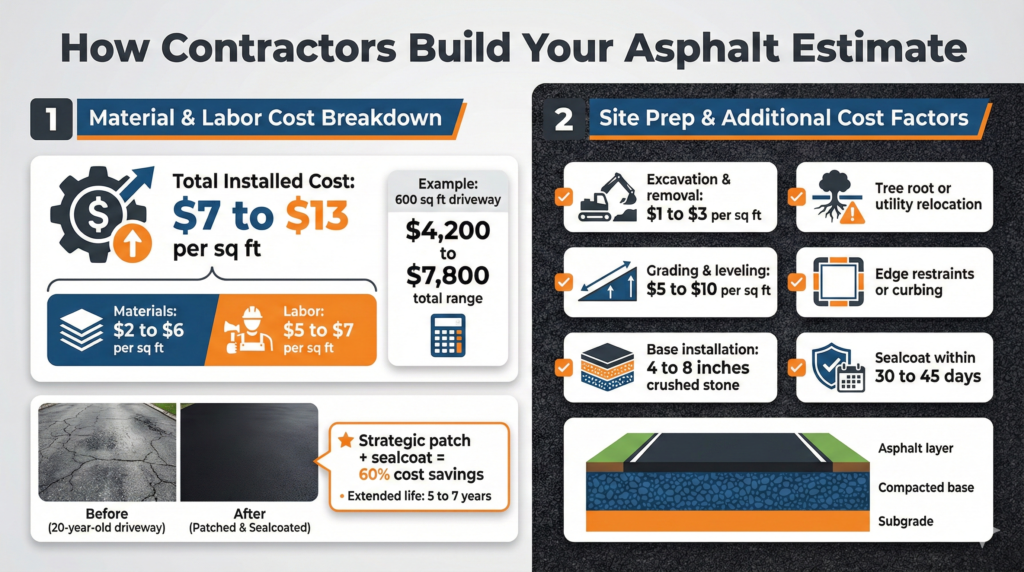
Your estimate should clearly show what you’re paying for. According to Angi’s 2025 cost data, a new asphalt driveway without major leveling or grading typically costs $7 to $13 per square foot installed. That breaks down to roughly $2 to $6 per square foot for materials and $5 to $7 per square foot for labor.
For a standard 600-square-foot residential driveway, total costs typically range from $4,200 to $7,800. However, your actual number depends on the specific conditions found during the site visit, the thickness of asphalt required, and any additional site preparation work.
One property owner we worked with had a 20-year-old driveway showing severe cracking and assumed they’d need a full replacement. After a thorough on-site evaluation, we identified that strategic patching of the major cracks followed by professional sealcoating was the better solution. The result was an extended driveway life of 5 to 7 years at 60% cost savings compared to full replacement, with a significant improvement in curb appeal. That’s the kind of value a proper site evaluation delivers.
Site Preparation and Additional Considerations
Beyond materials and labor, several factors can affect your total cost. A thorough estimate will account for:
- Excavation and removal of the old surface, if needed (typically $1 to $3 per square foot)
- Grading and leveling to establish proper slope ($5 to $10 per square foot for significant grading)
- Base material installation such as compacted crushed stone (4 to 8 inches deep for most residential projects)
- Tree root removal or utility relocation if obstacles are present
- Edge restraints or curbing to protect the borders of the new surface
- Initial sealcoating recommended within the first 30 to 45 days after installation
Understanding the full scope of the asphalt paving process in Texas helps you evaluate whether your estimate covers all the necessary steps.
What Should a Professional Paving Estimate Include?
Not all estimates are created equal. Knowing what to look for helps you tell the difference between a thorough, trustworthy proposal and one that might lead to problems later.
The team at Wolf Paving, drawing on 75 years of asphalt paving experience, advises that an experienced contractor should always visit your home or business in person. They emphasize that the estimator should discuss material options, communicate based on your preferences, and make sure you have all the information you need in a timely manner. A complete estimate, according to their guidance, goes well beyond a single number on a page.
Key Line Items to Look For
A professional paving estimate should include each of the following:
- Detailed scope of work describing exactly what will be done
- Material specifications including asphalt type, thickness, and base materials
- Labor costs broken out separately from material costs
- Site preparation details including grading, excavation, and base compaction
- Project timeline with estimated start and completion dates
- Warranty information covering both materials and workmanship
- Payment terms including deposit requirements and payment schedule
- Permit information if required by your local jurisdiction
Red Flags in a Paving Estimate
Use this comparison to evaluate any estimate you receive:
| Professional Estimate | Red Flag |
| Contractor visits the property in person | Quote given over the phone without a site visit |
| Detailed, itemized written proposal | Vague verbal estimate or single lump-sum price |
| Specifies material type and thickness | No mention of materials or base preparation |
| Includes timeline and warranty | No projected dates or guarantee of work |
| Contractor is licensed and insured | Unable to provide proof of licensing or insurance |
| Explains drainage and grading plan | Ignores water management completely |
| References from completed projects | No references or past work examples available |
| Written change-order process | No process for handling unexpected costs |
If an estimate seems unusually low compared to others, ask what’s being left out. Cutting corners on base preparation or material thickness can reduce upfront costs but often leads to premature failure. For more on evaluating contractors, see our guide on choosing the right asphalt paving contractor.
Your Next Step Toward a Lasting Paved Surface
A paving estimate visit is more than a formality. It’s the first real step toward a surface that will serve your property for years to come. With a properly maintained asphalt driveway lasting 15 to 30 years, the quality of that initial site evaluation directly affects the long-term performance and value of your investment.
By preparing your property, asking the right questions, and understanding what a professional estimate should include, you put yourself in the best position to make a smart, informed decision. The right contractor will take the time to evaluate your site thoroughly, explain their recommendations clearly, and deliver a transparent proposal you can trust.
Ready to get started? Contact C. Brooks Paving to schedule your free on-site paving estimate. We serve Bulverde, TX and the greater South Texas Hill Country region with the same care and craftsmanship that’s defined our family for four generations. Have questions about your specific project? We’re here to help.
Don’t forget to stay ahead of your pavement’s maintenance needs with regular professional inspections to protect your investment for the long haul.
Questions to Ask Your Paving Contractor During the Estimate
Asking the right questions during the estimate visit helps you evaluate the contractor’s expertise and ensures nothing falls through the cracks. Here are the top questions homeowners and property owners should ask:
How long have you been in the paving business, and do you specialize in residential or commercial work?
Experience matters. A contractor with years of hands-on work in your area will understand local soil conditions, climate challenges, and the best materials for South Texas properties. Look for a company with a proven track record and deep local knowledge.
What type and thickness of asphalt do you recommend for my project?
A standard residential driveway typically needs 2 to 3 inches of asphalt over a compacted gravel base. Heavier traffic areas or commercial lots may require 4 to 8 inches. Your contractor should explain why they’re recommending a specific thickness based on your specific situation.
How will you handle drainage on my property?
Proper drainage prevents water damage and extends the life of your pavement. The contractor should describe their plan for grading the surface and managing water runoff. In South Texas, where sudden heavy rainfall is common, drainage planning is especially critical.
What happens if you discover unexpected issues during the work?
A reputable contractor will have a written change-order process that requires your approval before any additional work or costs are added. You should never be surprised by hidden charges after the project has started.
Can you provide references from recent projects in the area?
Past work speaks for itself. Ask to see photos or drive by completed projects. A confident contractor will be happy to connect you with previous clients.